
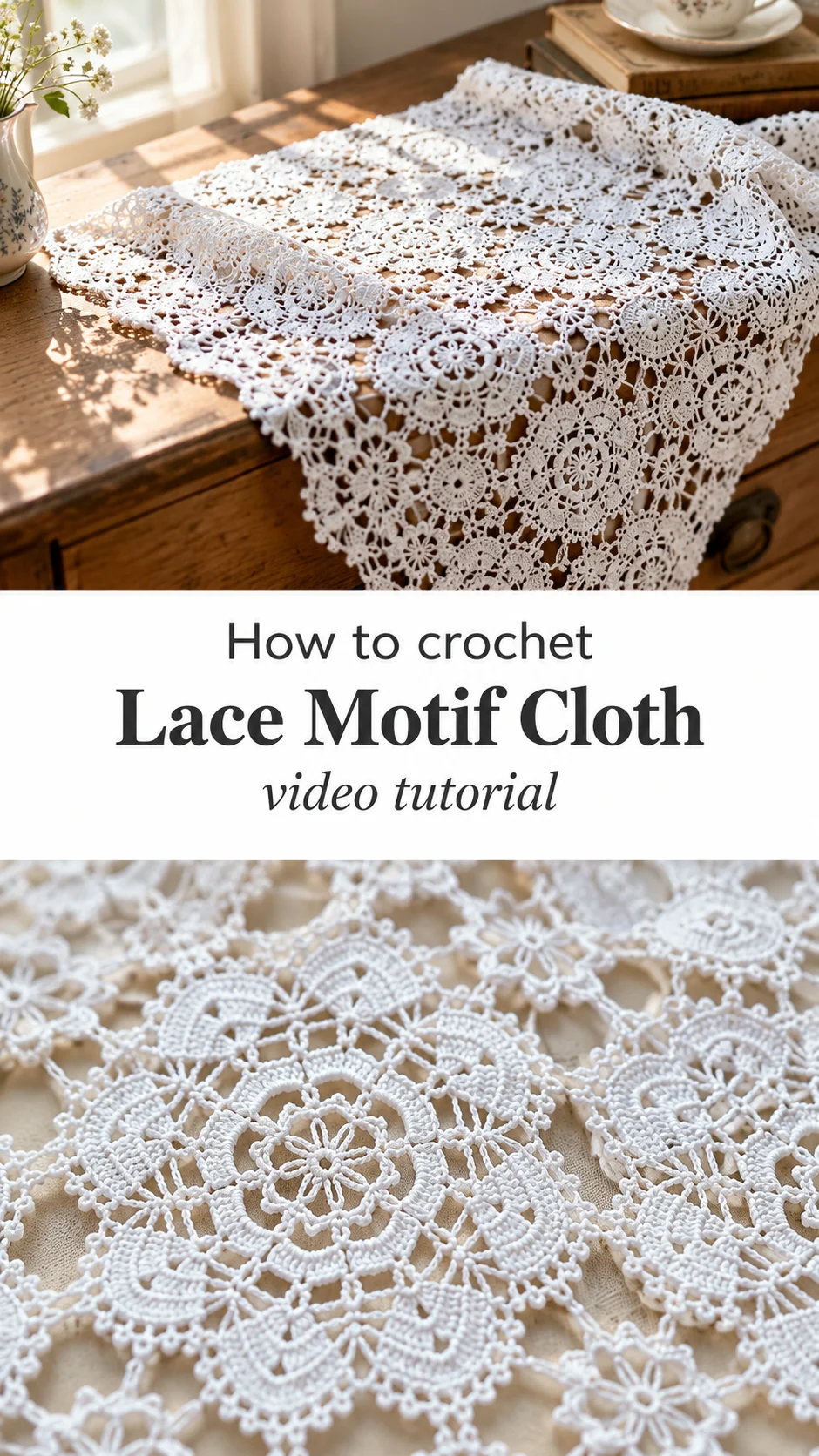
This crochet lace motif cloth is a web of tiny white flowers and teardrop petals, joined into a cover that feels airy, patient and quietly grand.
[IMAGE 1]
The Crochet Lace Motif Cloth
A crochet lace motif cloth is built from many small round flowers stitched together into one large, open piece. Each motif has a tightly worked centre with a spoked star, a ring of petals around it, and a ruffled outer edge of little picot loops. Smaller flowers sit in the gaps between the big ones, so the whole surface reads as a garden rather than a grid. The thread is fine, smooth and matte, and the colour is a crisp white with a faint blue cast in some light. Light passes through the mesh, which makes the cloth glow when laid over a dark table or a pair of hands. It suits a dresser top, a side table, a piano or a tray of tea things. Pieces like this are the sort families keep for decades.
Because the cloth is made of repeated motifs, it grows in a way that is easy to plan. You can stop at a small centrepiece or keep joining until the cloth drapes over a whole table. Either choice looks complete. It is also a lovely gift, and a good project for anyone who wants to practise neat, repeatable lace. Patience matters more than speed here.
[IMAGE 2]
Motif Cloth Related Posts:
- Crochet Dragon Scale Beanie: A Bold Winter Essential
- Crochet Marshmallow Basket: A Fluffy and Charming Storage Solution
- Crochet Flower Granny Square: A Charming Floral Classic
- Crochet Gingham Pillow Cover: A Charming Home Accent
Materials
For a crochet lace motif cloth, choose a fine mercerized cotton thread, the kind sold for doilies and lace, in white or ivory. Mercerized cotton has a gentle sheen, holds each stitch crisply and survives repeated washing, which matters for a piece that will sit under vases and teacups. A steel hook in the small range, roughly 1.5 to 2 mm, suits thread this thin, and a comfortable handle will save your hand over hundreds of tiny stitches. The cloth shown looks worked in a thread close to size 10, and a thicker cord would make the petals clump and lose their crisp outline. You will also need a tapestry needle with a small eye for weaving ends, rustproof pins and a flat padded surface for blocking, plus a little fabric stiffener or sugar starch if you want the edges to stand proud.
[IMAGE 3]
The Motif: Teardrop Petals Around a Star
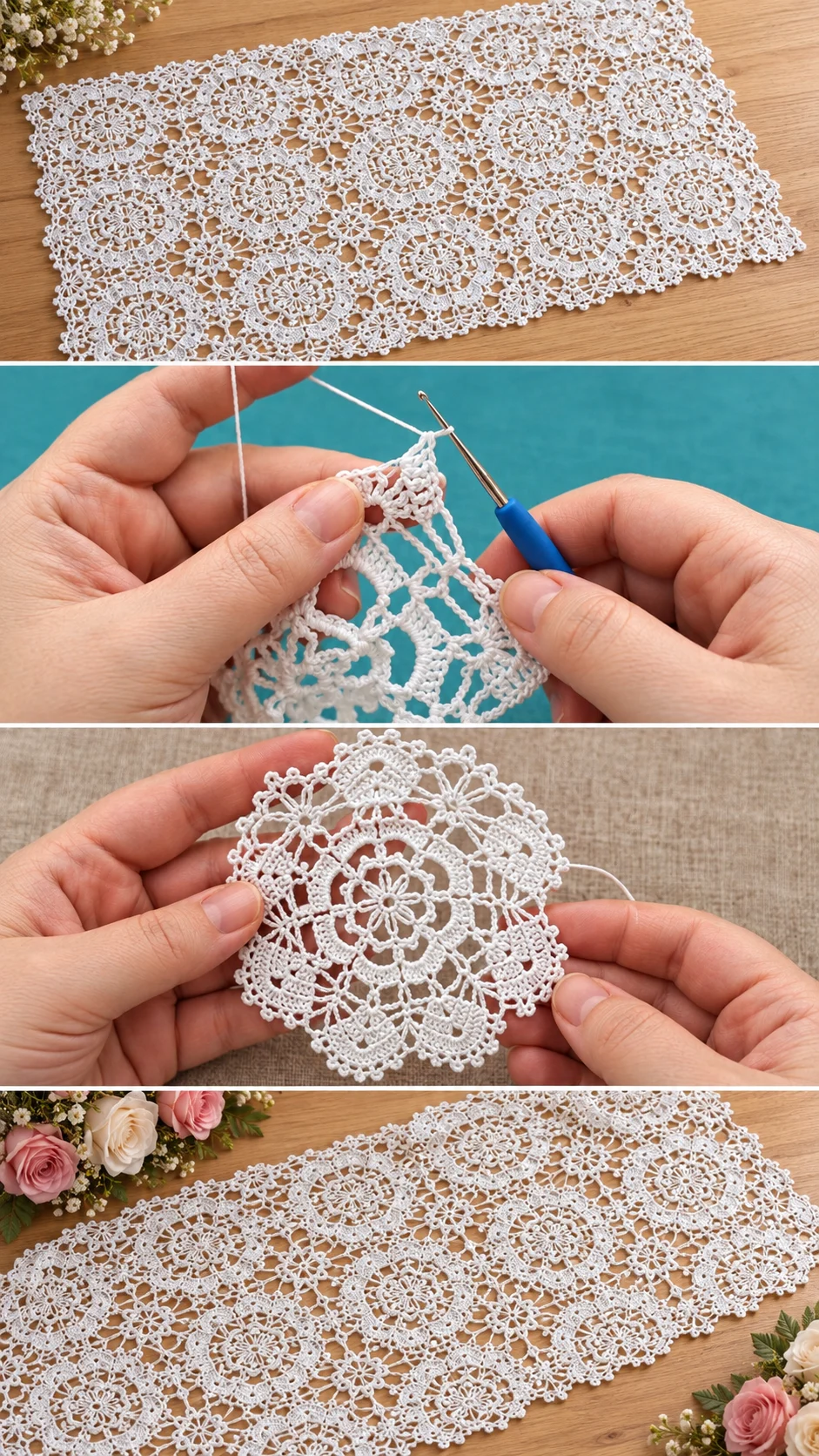
Every large motif follows the same plan. A small star of spokes sits at the centre, wrapped by a round of airy chain loops. Around that, six rounded, filled petals curve in the same direction, each shaped like a leaf or teardrop with a little eyelet near its tip.
The contrast between solid petals and open mesh is what gives the cloth its depth. The petals are dense and flat, while the space around them is all chains and light. Keeping that contrast depends on even tension, so aim for the same pull in every petal.
The outer round finishes each motif with a row of tiny picots, which makes the edges look like lace trim. Work these loosely enough that they can be pinned out later. Tight picots curl inward and hide the pattern.
Understanding How the Motifs Join
The motifs are not sewn together afterwards. In the video, a close look at the hands shows the join happening as the last round is worked, with groups of double crochet stitches meeting a neighbouring motif at set points. That approach saves you the seaming and keeps the cloth flat.
Watch how the working thread is carried from one motif to the next, and pause where the hook enters the finished motif. This is the step where beginners lose their place. If the join lands a stitch off, the petals sit crooked and the gap between motifs shows.
The small flowers in the gaps are joined the same way, connecting at points around their edge. They act as spacers, so if your large motifs come out slightly larger than the ones in the tutorial, the small flowers will pucker. Check the first two or three joins before you commit to the full cloth.
Keeping the Joins Even
Join every motif in the same order. If one corner is joined first on one motif and last on the next, the tension shifts and the fabric ripples. If you see a ripple, loosen the joining stitches a touch rather than pulling the motif straight.
Choosing the Best Thread for a Delicate Lace Cloth
Thread decides how this cloth looks and lasts. Fine mercerized cotton gives sharp petals and a soft shine, and it tolerates starch and hot washing. Linen thread produces an even more heirloom look with a crisp, slightly rustic hand, though it is tougher on the fingers and softens with age.
A cotton and acrylic blend is easier to wash but tends to lose definition when blocked, so the petals look rounder and less precise. Avoid anything fuzzy or loosely plied, because it hides the eyelets that make this design read as lace.
For colour, white or ivory is the classic choice and the one pictured. Ecru gives a warmer, vintage feel on a wooden table. Pale blue or soft grey works for a modern room. Keep the colour light, since dark thread flattens the open mesh into a shadow.
How to Style a Crochet Lace Motif Cloth
The most natural place for this cloth is on a wooden surface, where the white thread stands out against warm grain, just as it does beside a vase of cream and peach roses. A smaller four-motif version also looks charming as a centrepiece, with a candle or a small figurine in the middle flower.
For a bigger version, lay it over a plain dark runner on a dining table so the openwork shows. It also works draped over a dresser, a console or the lid of an upright piano, where the scalloped edge can hang slightly over the side.
As a gift, a cloth like this suits weddings, anniversaries and housewarmings. Roll it loosely in tissue paper and tie it with ribbon so the edges are not creased. Do not fold it tightly, because the picots hold creases.
Tips for Blocking and Finishing
Blocking is what turns a slightly crumpled bundle of motifs into lace. Wash the finished cloth gently, press out the water in a towel, then pin it flat on a padded board, easing each motif into a round shape and pulling the picots into points. Let it dry fully before unpinning.
If the cloth feels limp after drying, apply a light sugar or fabric starch and block again. If the edges ripple, your joins were probably too tight, and pinning each motif to the same size will relax most of it. If the cloth looks too small, stretch it a little more when pinning, since cotton lace has plenty of give.
Weave in every end along the thread’s own path, going back through two or three stitches in each direction. Trim only after blocking, because lace tugs the ends as it settles. A loose tail on a fine thread will work its way to the surface within a few washes.
Following the Tutorial
Work one large motif completely before attempting any joins, so you know the petal rhythm by heart. Pause the video whenever the creator shows the group of double crochet at a join, since the stitch position is easy to miss at normal speed.
Make the small flower connectors after you have two large motifs ready, and test how they sit between them. Then add motifs one at a time rather than finishing all the large ones first. That order lets you catch a sizing problem while it is still cheap to fix.
Lace like this takes time, and the repeated motifs are slow at first, then suddenly quick as your hands learn them. The hardest part is usually the joining round, so give it your freshest hour of the day.
A Delicate Handmade Heirloom
This crochet lace motif cloth is a field of petals, stars and tiny flowers, joined into a piece that looks as fine as old linen. It rewards slow, careful work.
Four things decide how it turns out: a fine, smooth cotton thread, an even tension in the petals, joins worked in the same order every time, and a generous blocking at the end. Get those right and the cloth will lie flat and sparkle with light.
Small stitches, long memory.
Video tutorial for this crochet lace motif cloth by the original creator, linked below.
[VIDEO]
Follow us on Pinterest and subscribe to the Newsletter so you don’t miss a thing!
Tutorial and photos of this lace motif cloth by: Crochet Swan.