
A crochet lace doily is a small square of airy white thread work, built from fans and clustered blocks that catch the light like frost on glass, and it gives any table a quiet, finished look.

The Crochet Lace Doily
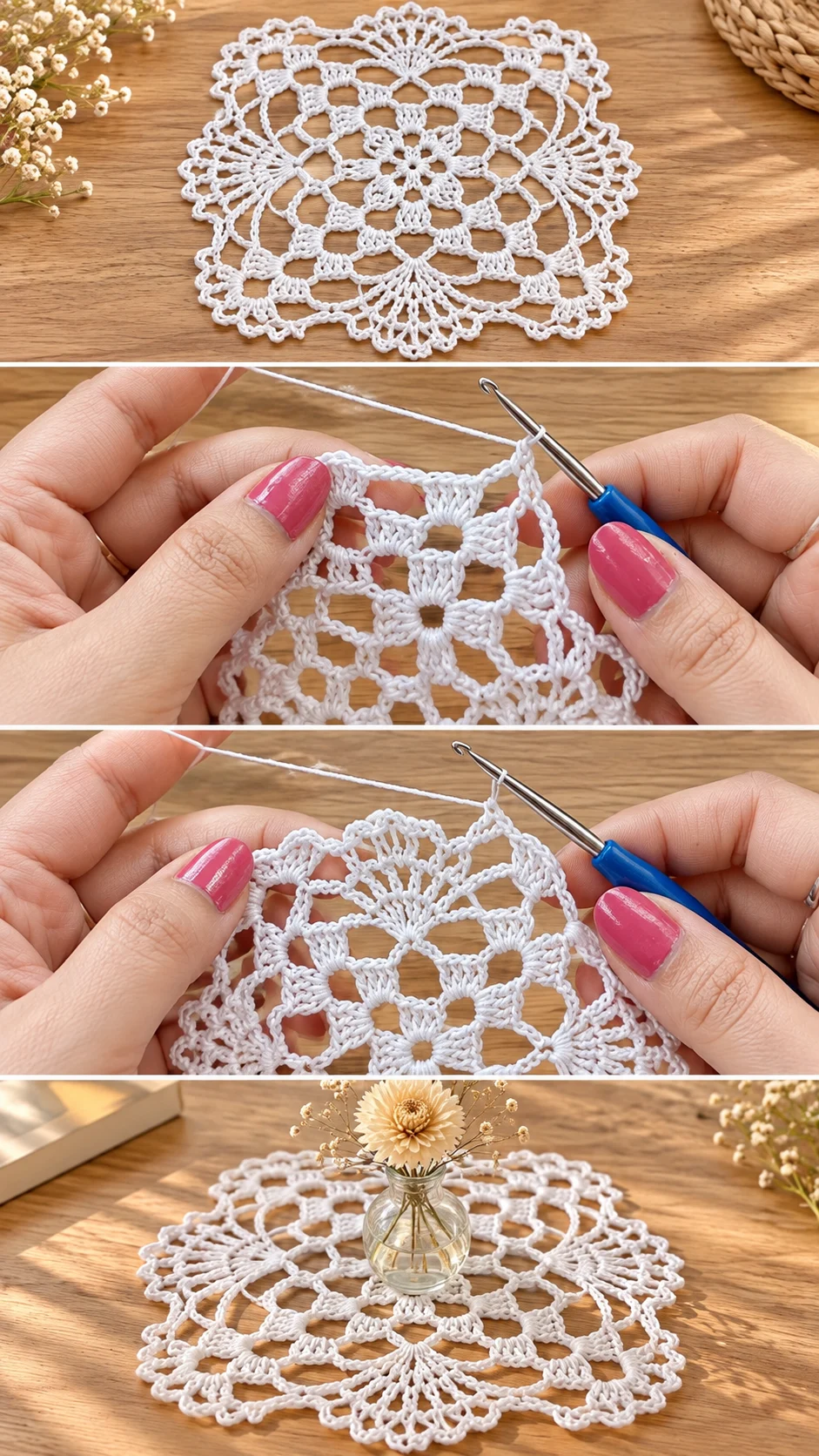
This crochet lace doily is a square of fine white thread with an open, web-like structure. A grid of small double crochet blocks sits at the centre, set against tiny square holes that give it a checkerboard rhythm. Shell and fan clusters bloom at the edges and along the sides, so the outline curves softly instead of ending in a flat line. The thread is smooth and matte, and it looks closer to a thin cotton than to ordinary yarn. Each stitch stays crisp, which is what makes the lace read so clearly. The piece looks right on a wooden side table, under a vase, beneath a candle, or on the arm of a chair. It is small, quick to admire, and easy to repeat.
A single square also works as a motif. Joined together, the same design becomes a larger runner or a tablecloth, with the fan clusters meeting at the corners to form bigger flower shapes. That makes it a flexible project: make one as a coaster-sized gift, or keep going until a whole table is covered. It builds comfort with chain spaces and block patterns without demanding anything exotic. Patient. Rewarding.
Lace Doily Related Posts:
- Crochet Flower Basket: A Soft and Charming Accent
- Crochet Floral Tablecloth: A Timeless Handmade Treasure
- Crochet Chunky Bean Stitch Hat: A Warm Winter Essential
- Crochet Old Money Cardigan: A Timeless Elegant Classic
Materials
For a crochet lace doily like this, choose a fine mercerized cotton thread in white or ecru, because the sheen and firm twist keep every chain and cluster sharply defined. The stitches in the finished square look small and tight, so a steel hook in a small size, roughly 1.5 to 2 mm, is a sensible general range, adjusted until the fabric feels springy rather than stiff. Thicker yarn would blur the tiny holes and turn the lace into a heavy, closed fabric, while a loose hook would let the fans sag. You will also need a tapestry needle for weaving ends, a few rust-proof pins for blocking, a foam mat or clean towel, and a little fabric stiffener or sugar starch if you want the piece to hold a crisp shape. A short, well-lit workspace helps too, since fine thread is hard on the eyes.
Understanding the Construction
The square appears to be worked in the round from the centre outward, with each round adding a new band of blocks and chain spaces. The corners carry the shaping, which is why the finished piece has four distinct points where the fans gather. Think of it as four identical sides that meet at the corners.
Early rounds are compact, with the little double crochet blocks sitting close together around a small central opening. As the rounds grow, the chain spaces lengthen and the fan clusters take over, so the outside feels lighter than the middle. This gradual opening is what gives the doily its graceful gradient from dense to airy.
Because the pattern repeats, a good habit is to treat each side as one unit and check it before moving on. If one side holds a block more or fewer than the others, the error is easier to spot early than after three more rounds. Pause the video at each corner and compare your work with the creator’s.
The Stitch Pattern: Blocks, Fans and Chain Spaces
Three stitch families do the work here. Small blocks of double crochet form the solid squares that run diagonally through the centre. Chain spaces form the open windows between them. At the edges, double crochets are grouped into fans, with a short chain gap separating each stitch so the cluster fans open like a shell.
That fan is the signature detail of the piece. In the tutorial, one row calls for a chain of six followed by seven double crochets with a single chain between each, and this is what shapes the scalloped, flower-like edge. The mistake to avoid is skipping or doubling the single chain. If the fan looks squashed, a chain is probably missing; if it flares too wide, one is extra.
Count the double crochets in each fan before closing it, since seven stitches sit neatly while six or eight tilt the whole corner. A removable stitch marker in the centre stitch of each fan keeps your place when you return to the work later.
Keeping the Corners Sharp
The corners are where lace squares most often go wrong. If they curl inward, the corner clusters are too tight; loosen your tension slightly on those stitches. If they stick out like ears, the chain spaces there are too long. Aim for corners that lie flat on the table before blocking, and let blocking handle the rest.
Skill Level and Patience
This is a confident beginner to intermediate project. The stitches are simple: chains, double crochets and slip stitches. The challenge is not technique but attention, since the pattern depends on consistent counting and small thread.
The slowest part is the outer fan rounds, where every fan needs its own careful count and the thread is easy to split with the hook. Work in good daylight, take breaks, and rest your eyes. If your hand tires, loosen your grip, because tight tension makes fine thread harder to handle and the fabric stiff.
Making one square before committing to a larger project is a smart move. It shows whether your gauge gives the airy look in the photos and gives you a chance to learn the repeat on something small.
Blocking for a Crisp Finish
Fine cotton lace looks limp straight off the hook, and blocking transforms it. Dampen the square, lay it on a foam mat, and pin out each corner and each fan point so the scallops open fully. Let it dry flat. If the edges ripple, pin more points along each side; if the shape springs back, a light application of fabric stiffener will set it.
Check the square against a ruler while pinning so all four sides match. A doily that is slightly out of square is much more noticeable than one with a small size difference between copies.
How to Style a Crochet Lace Doily
The white square suits a dark wooden table especially well, where the open holes let the grain show through. Place it under a small vase, a candle in a glass holder, or a ceramic bowl of keys by the front door. The contrast between pale thread and warm wood is part of its charm.
Beyond the table, try it under a teacup and saucer for a tea tray, framed behind glass as wall art, or stitched in groups onto a cushion cover or a plain linen runner. Made in ecru or cream, the same design looks softer and more vintage. A set of four also makes a thoughtful housewarming gift.
Tips for a Neat Finished Piece
Weave in ends along the solid blocks rather than through the chain spaces, where a tail can show through the holes. Use the needle to run each end back and forth for a few centimetres so the cotton cannot work loose.
If your square comes out smaller than expected, do not force it; block it more firmly or try a slightly larger hook next time. If it comes out too stiff, the hook is too small for the thread. If the fans look cramped, loosen up on the chain between double crochets.
Wash finished pieces by hand in cool water with mild soap, press in a towel, and reshape while damp. Machine washing can snag and stretch fine lace.
A Delicate Handmade Heirloom
The crochet lace doily is a small, patient piece of work with a lasting payoff. Its charm lies in the fine white thread, the checkerboard of blocks, and the fans that bloom along each edge.
Three things decide how it turns out: a smooth cotton thread with a matching small hook, consistent counting in every fan, and careful blocking. Get those right and a simple square becomes something worth keeping.
Soft thread, steady hands.
Video tutorial for this crochet lace doily by Crochet World Creations.
Follow us on Pinterest and subscribe to the Newsletter so you don’t miss a thing!
Tutorial and photos of this lace doily by: Crochet World Creations.