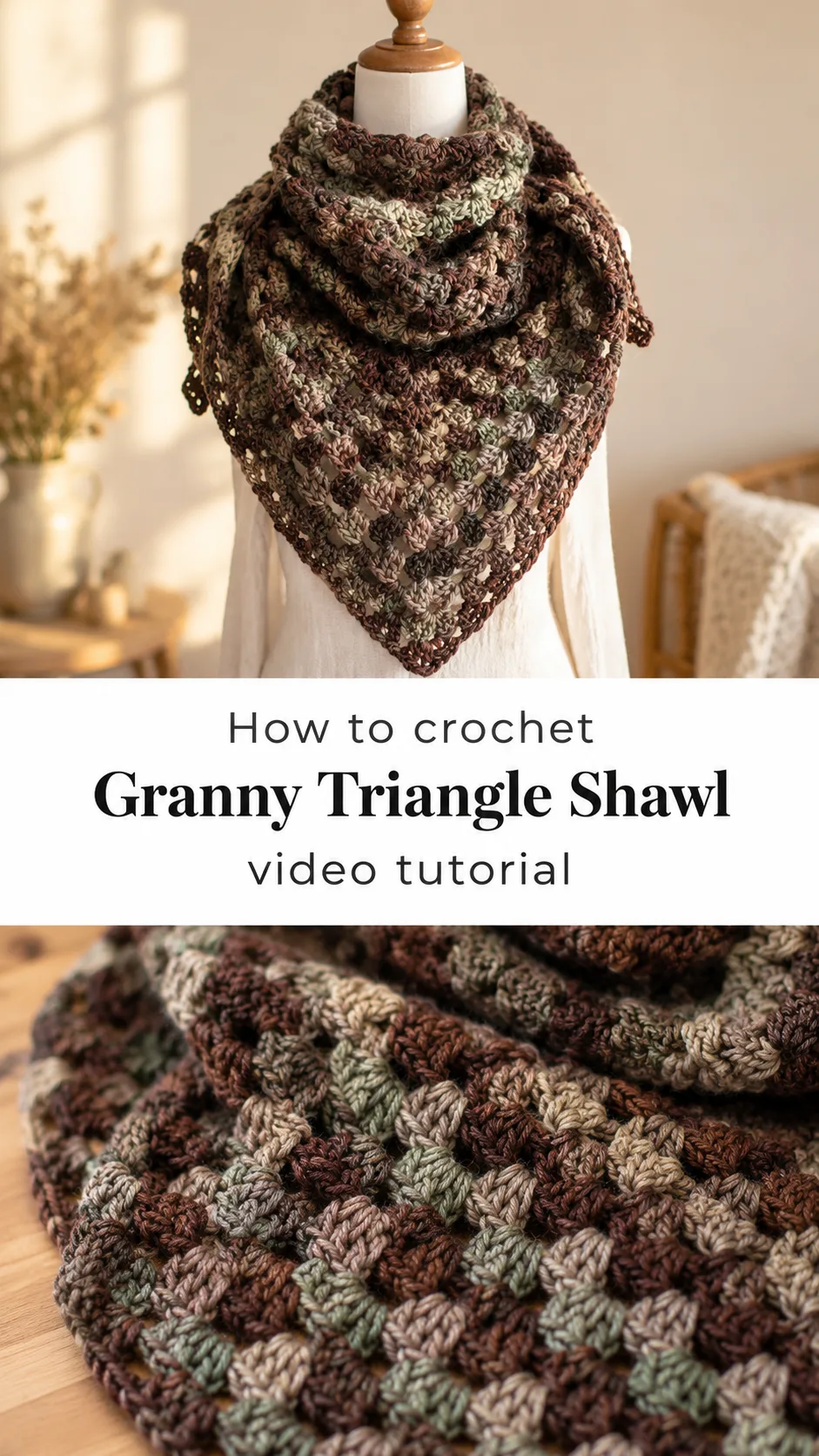
A crochet granny triangle shawl wraps the shoulders in soft, open clusters and shifts quietly through shades of chocolate, taupe and sage as it grows. It is a relaxed, cosy make with a bohemian feel.
IMAGE
The Crochet Granny Triangle Shawl
The crochet granny triangle shawl is built from classic granny clusters, those little groups of double crochets separated by chain spaces. Together they form an airy, lightly textured fabric. The yarn is the star here. It shifts from deep espresso brown through dusty mauve and warm taupe to pale sage grey, so the colour changes by itself as the rows grow. The shape is a deep triangle with a long point at the front and two ends that can be tied or tucked. Because the clusters leave small openings, the fabric stays light while still feeling warm. It sits comfortably around the neck as a cowl-like scarf or spreads across the shoulders as a wrap. Think of crisp autumn walks, chilly offices and cool evenings on the porch.
This is a shawl that works as three things at once: a scarf, a bandana-style cowl and a light wrap. Fold the point to the front and knot the ends behind, or let it hang loose. It makes a good gift for anyone who likes earthy colours. It also teaches how a simple repeat can carry an entire project.
IMAGE
Triangle Shawl Related Posts:
- Crochet Strawberry Tote Bag: A Sweet Summer Essential
- Crochet Mesh Lace Shawl: A Delicate Timeless Classic
- Crochet Lace Motif: A Delicate Floral Masterpiece
- Crochet Crocodile Stitch Bag: A Textured Elegant Treasure
Materials
For a crochet granny triangle shawl you need a single long-run gradient or variegated yarn, ideally a soft worsted or light bulky weight with a gentle twist. The shawl in the photos looks to be worked in a colour-shifting acrylic or wool blend in browns, taupes and sage, and a yarn that changes colour by itself saves you from switching skeins and weaving extra ends. Choose a hook one size larger than the label suggests, typically around 5 to 6.5 mm for this weight, because granny clusters need room to stay open and drape instead of stiffening. A smooth, round-tipped hook helps you slide into chain spaces without splitting the strands. You will also want a yarn needle for weaving in ends and a pair of scissors. Stitch markers are optional but handy for flagging the centre point.
IMAGE
Choosing the Best Yarn for This Shawl
A self-striping or gradient yarn is what gives this shawl its quiet, blended look. The colour changes are gradual, so the bands read as soft shading instead of hard stripes. That suits the clusters well, since each little group of stitches shows a slightly different tone from its neighbour.
A wool blend gives you warmth and a pleasing bounce, and it blocks nicely if you want crisper edges. Acrylic is more budget-friendly and easier to wash, though it can feel slightly less breathable. Cotton is the one to avoid for this shawl. It has no stretch and the clusters would hang heavily and sag at the point.
Avoid very fuzzy yarns such as mohair blends. They hide the cluster definition, and the open spaces that make a granny pattern recognisable would blur into a haze. A smooth strand with a visible ply shows the stitches clearly.
If you prefer other colours, look at gradients that move between similar tones, such as navy to slate to pale blue, or rust to caramel to cream. Keep the shift gentle. Strongly contrasting shades fight with the lacy texture and pull the eye away from the shape.
Granny Clusters: The Stitch That Builds the Shawl
Granny clusters are groups of double crochet stitches worked into the same space, divided from the next group by a chain. In the shawl they create a rhythm of small solid blocks and little windows. Each row sits neatly on the one below, and the clusters stack in a pattern you can follow with your eye.
The fabric is open rather than dense, which is why it drapes so well. The windows trap a little air, so the shawl is warm without being heavy. Up close you can see the clusters as rounded, slightly puffy groups, with the gaps between them forming a loose grid.
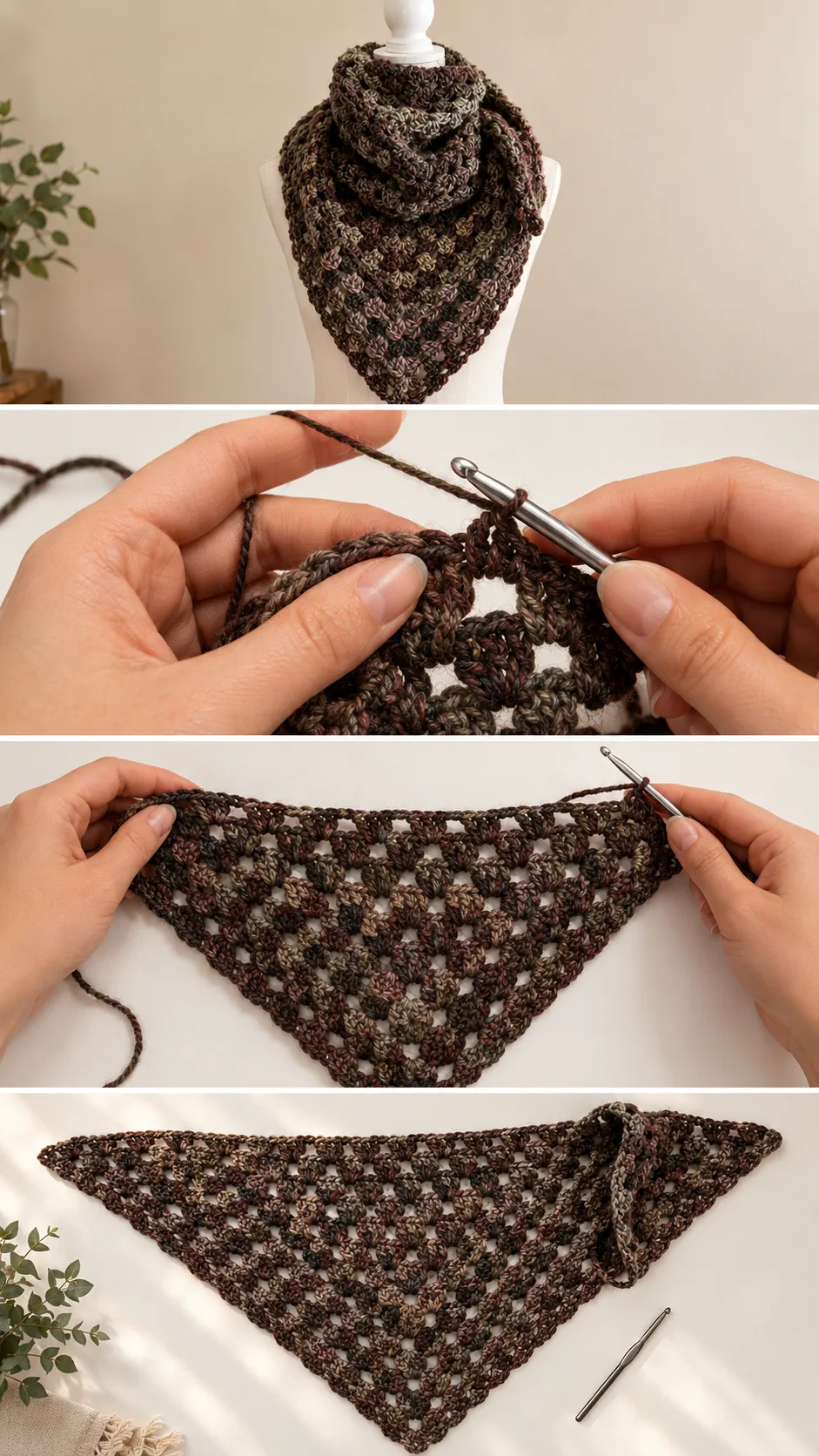
The tricky moment is working into the chain space instead of the stitches themselves. If you stitch into the top of the previous cluster, the fabric tightens and the triangle slowly distorts. Pause the video when the creator inserts the hook and copy exactly where it goes.
If your fabric feels stiff, go up a hook size. If the clusters look gappy and loose, go down half a size or check that you are pulling each chain snugly. Consistent chain length matters more than speed.
Shape and How It Grows
The shawl is worked as a single piece, with the triangle widening row by row. The point of the triangle falls at the bottom front, and the long top edge wraps around the neck. The shaping happens at the corners and along the centre, where extra clusters are added so the sides keep their angle.
Watch the corners closely. Each row adds clusters at the edges, which gives the triangle its steady, even slope. In the shawl the two long sides run straight to the point, so the increases look consistent from the first row to the last.
The colour changes make it easy to see how the shape grows. Each band of shade is a little wider than the one before it, because every new row is longer. That is why the darker brown ends up looking like a broad band while the sage tones appear toward the upper edge.
If the edges ripple, you probably added too many stitches in the corner. If they pull inward, you may have skipped one. Count your clusters at the end of every few rows and compare against the video to catch a slip early.
Skill Level and Patience
This is an approachable project for confident beginners. If you can chain, slip stitch and double crochet, you already have the main skills. The repeat is easy to memorise after a few rows, so the work soon becomes calm and rhythmic.
The part that takes patience is the length of the later rows. As the triangle grows, each row has more clusters, so the final stretch feels slow even though the stitches are the same. Watching a favourite show while you work helps the rows pass.
Beginners often lose count of clusters at the corners. Place a stitch marker in the corner space of each row so you can find it instantly. Moving the marker up as you go saves a lot of frustration.
Keeping the Tension Even
Tension changes as you relax into a long project. Early rows are often tighter than later ones, which shows up as a subtle shift in drape. Check your chains now and then against the first few rows and loosen your grip if they are shrinking.
Blocking and Finishing Tips
Weave in the ends along the cluster edges, running the needle through the base of several stitches so nothing works loose. A colour-shifting yarn means fewer ends, which is a quiet bonus. If you did join a new ball, hide that tail inside a cluster where the colour is similar.
Blocking helps this shawl settle into its shape. Pin the triangle out gently, steam or spritz it, and let it dry flat. Wool blends respond well and the clusters even out. Acrylic needs only a light steam held above the fabric, never pressed, because heat can flatten it for good.
Check the long top edge before wearing. If it curls slightly, a little blocking will calm it. If it still rolls, adding a row of single crochet along that edge gives it a firmer, neater finish.
How to Style a Crochet Granny Triangle Shawl
On the form, the shawl is worn with the point forward and the ends gathered behind the neck, giving a bandana-style cowl with a soft fold at the collar. The warm brown tones read well against a plain white and grey backdrop, so it suits simple outfits where the shawl is the focus.
For everyday wear, drape it over a cream knit sweater and dark jeans for an easy autumn look. The browns pick up leather boots and the sage tones pair with olive or khaki jackets. Leave the ends loose for a relaxed shape.
For cooler evenings, spread it across the shoulders over a plain long-sleeved dress and fasten it with a shawl pin. The open clusters let the dress colour peek through, which gives a layered look. Swap the pin for a simple knot when you want it to stay put on windy days.
Following the Tutorial
Start by watching the whole video once without your hook. Notice how the creator sets up the first rows and where the centre point forms. Then begin again and work alongside, pausing at each new row to compare your fabric.
Pay special attention to how the hook enters the chain spaces and how the corners are handled. These are the moments where small differences change the whole shape. Replay them as often as you need.
Keep your yarn ball in a small bag or bowl so the colour changes unwind smoothly. A tangled strand interrupts the rhythm and can tighten your chains without you noticing.
A Cosy Handmade Wrap
The crochet granny triangle shawl is a soft, wearable piece built from one simple cluster and a yarn that does the colour work for you. It drapes lightly, wraps warmly and suits earthy wardrobes.
Three things decide how it turns out: a smooth colour-shifting yarn, a hook large enough to keep the clusters open, and careful stitching into the chain spaces. Add gentle blocking and the shape settles beautifully.
Cast on, find the rhythm, and wear it all season.
Video tutorial for this crochet granny triangle shawl by the original creator; watch it on their channel via the link below.
VIDEO
Follow us on Pinterest and subscribe to the Newsletter so you don’t miss a thing!
Tutorial and photos of this granny triangle shawl by: B.Hooked Crochet.