
A free video tutorial is available to guide you through every stitch of this beautiful Crochet Lace Table Runner, so you can follow along with confidence at your own pace. The open-grid pattern creates an airy yet structured mesh that feels almost impossibly delicate for how straightforward it actually is to make!
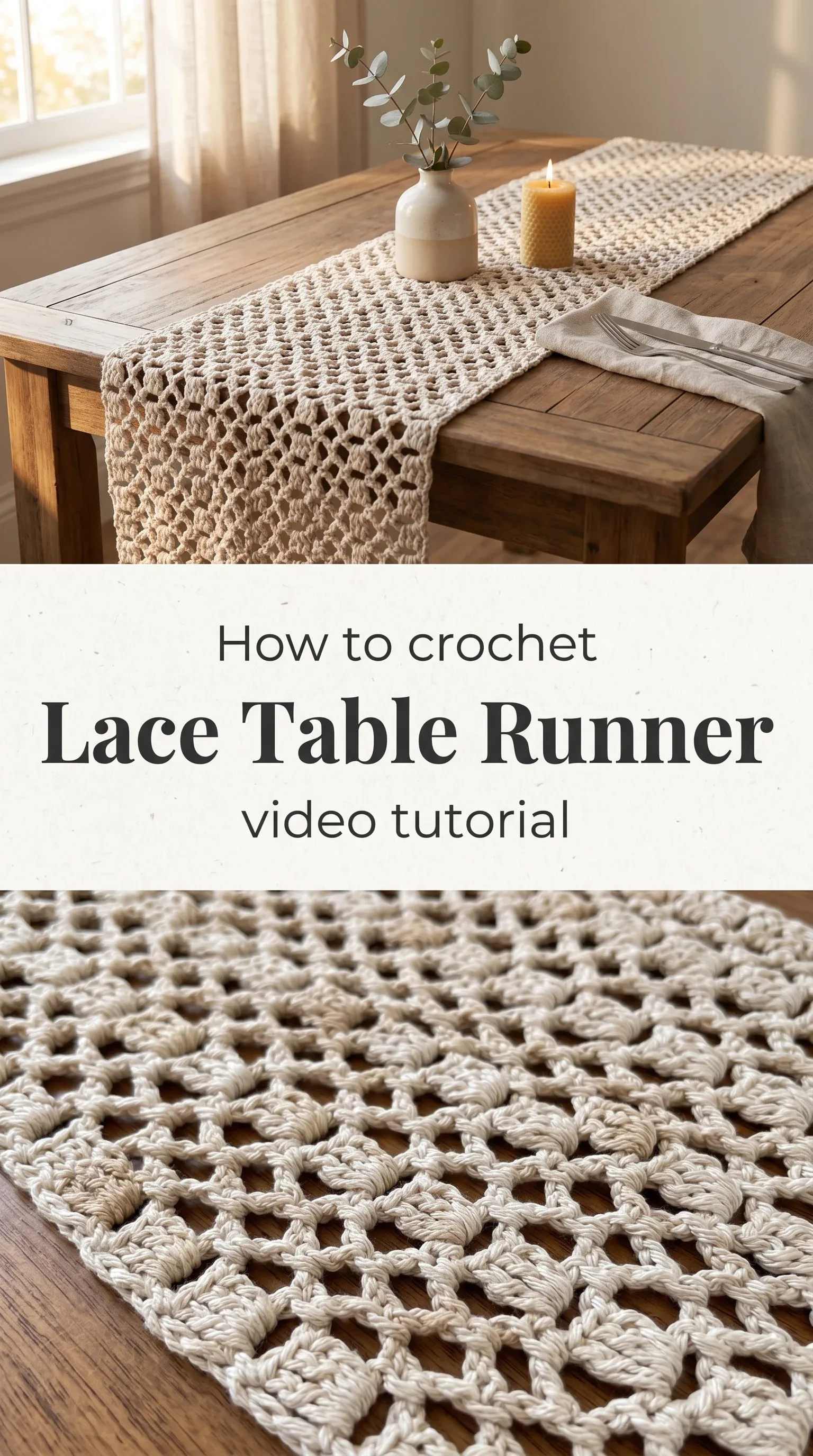
The Lace Table Runner
A Crochet Lace Table Runner carries a whisper of elegance that transforms an ordinary surface into something worth pausing over. It is the kind of piece that catches afternoon light and holds it, casting small shadows through its open lattice onto the wood beneath, making even a simple dining table feel considered and loved. This runner is for the maker who appreciates slow, intentional craft, the one who wants their home to feel handmade without feeling heavy. Whether you are a confident beginner building your first home accent or an intermediate crocheter looking for a meditative weekend project, this piece meets you exactly where you are.
Table Runner Related Posts:
- Crochet Pom Poms: A Quick and Playful Accent
- Crochet Summer Blouse: An Incredible Warm Weather Essential
- Crochet Rustic Star Blanket: A Timeless Cozy Essential
- Crochet Lace Runner: A Delicate Decorative Treasure
Natural ecru and warm sand tones suit this Crochet Lace Table Runner beautifully, honoring the organic quality of the open mesh and letting the texture speak for itself. A soft ivory works across every season, from linen-layered summer tablescapes to candle-lit autumn gatherings, while a deeper oat or stone shade adds a grounded, earthy warmth. If you want to make something more unexpected, a dusty sage or muted blush can shift the whole feeling without changing a single stitch.
Materials and Tools
For this Crochet Lace Table Runner, a DK weight cotton or cotton-blend yarn is the ideal choice, giving the finished piece that clean, structured drape you can see in the reference images. Cotton holds its shape beautifully through blocking and has a slight sheen that makes the lacework pop against a table surface. A 4mm crochet hook works perfectly with DK weight at this gauge, producing holes that are open and airy without losing their definition. Keep a yarn needle close by for weaving in ends neatly, as the openwork structure makes any loose tail more visible than it would be in a dense fabric.
Stitch by Stitch
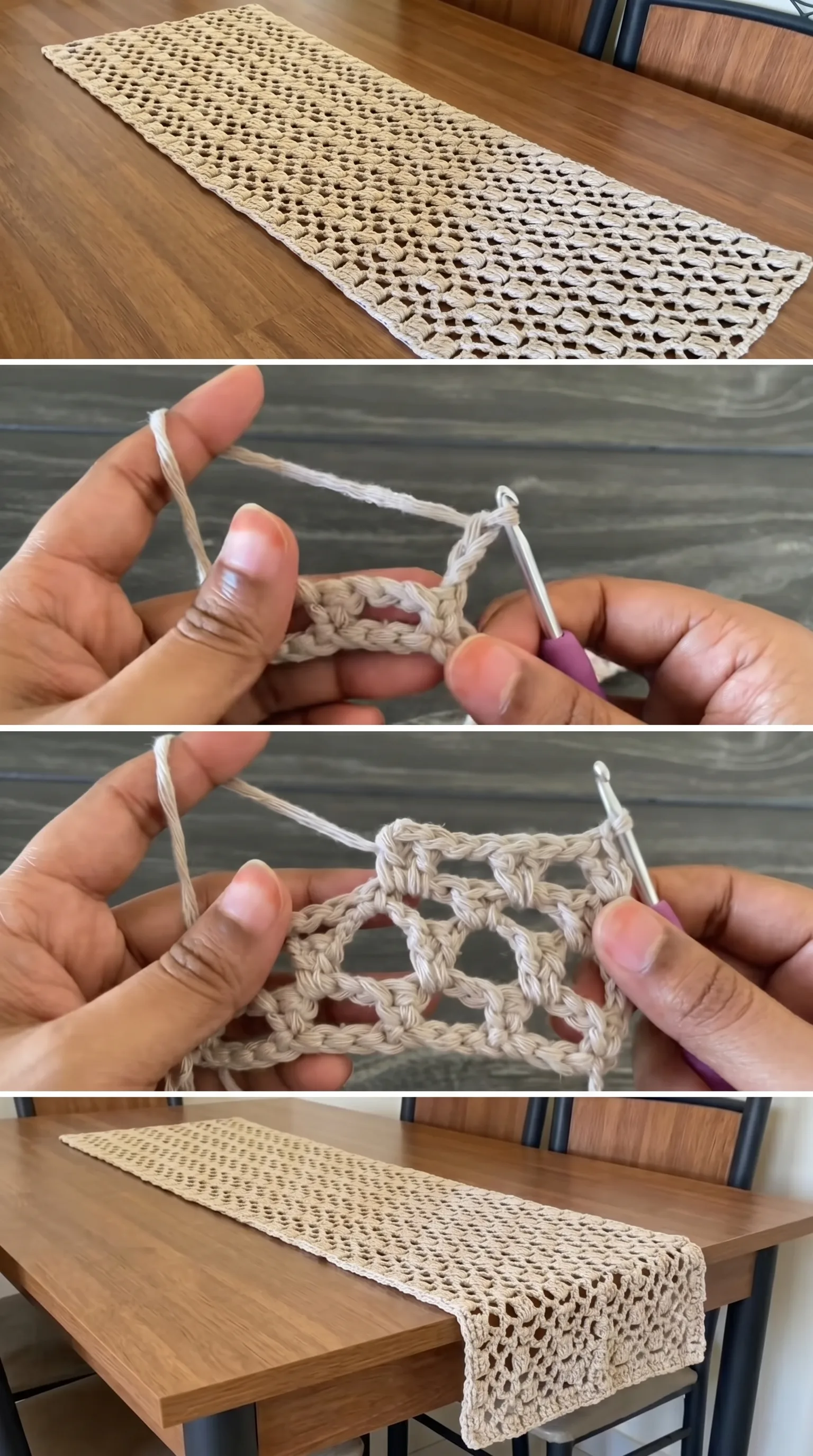
This pattern draws on a small, satisfying collection of stitches that build into the lace grid you see spread across the finished runner.
BULLET:CH (Chain) The foundation and the bridge between clusters, the chain stitch creates the open spacing that gives this lace its characteristic breathable structure.
BULLET:SC (Single Crochet) Used to anchor and close sections of the grid, the SC provides firm, neat points that keep the lacework from stretching out of shape.
BULLET:DC (Double Crochet) The workhorse of this pattern, the DC builds height and structure within each cell of the mesh, creating those satisfying raised columns visible across the runner.
BULLET:YO (Yarn Over) Every DC and cluster begins with a yarn over, and mastering a smooth, consistent YO is what gives the finished fabric its even, polished appearance.
Once you find the rhythm of moving from cluster to chain space to cluster, the pattern settles into something genuinely meditative, the kind of repetitive flow where your hands know what to do and your mind can wander softly.
Construction
The Crochet Lace Table Runner is worked flat in rows, building from a foundation chain to your desired width before growing row by row to your preferred length. This straightforward construction makes it genuinely beginner-friendly, as there are no joins, no working in the round, and no shaping to navigate. The full video tutorial walks through the stitch repeat clearly so you can see exactly how each row builds on the one before it, including how the color shift from the natural tan to the lighter tone is handled if you choose to incorporate it. To customise the size, simply adjust your starting chain in multiples of the stitch repeat to make a narrower table runner, a wide table cloth, or even a set of matching placemats.
Wearing Your Lace Table Runner
Lay your finished Crochet Lace Table Runner down the centre of a farmhouse dining table with a cluster of pillar candles and some dried botanicals, and the whole room shifts into something slower and more intentional. It works equally well draped across a console table in a hallway, underneath a vase or a stack of books, softening hard furniture with its open texture. Finishing this piece gives you something genuinely functional and beautiful, the kind of handmade object that other people notice and ask about.
Washing and Caring for Your Lace Table Runner
Because this runner is worked in cotton or a cotton blend, it responds wonderfully to wet blocking after finishing, a process where you soak the piece, gently press out the excess water, and pin it flat to its final dimensions while it dries. Blocking opens up the lace cells, evens the tension across the whole fabric, and gives the finished runner that polished, intentional look you see in the images. For regular washing, a gentle machine cycle in a mesh laundry bag or a careful hand wash in cool water will keep the cotton fibres clean without distorting the structure. Store it flat or rolled loosely rather than folded sharply to prevent crease lines forming across the open mesh.
Every Crochet Lace Table Runner you make carries the quiet weight of time given generously, and that is something no mass-produced home accent can replicate. Save this post to your Pinterest boards and share your finished runner in the comments, because this community loves seeing your beautiful, handmade homes come to life.
Follow us on Pinterest and subscribe to the Newsletter so you don’t miss a thing!
Tutorial and photos of this lace table runner by: Beyond Diary.