
A crochet fishnet tunic turns a simple open mesh into something light enough for the hottest day and refined enough to wear all summer long.
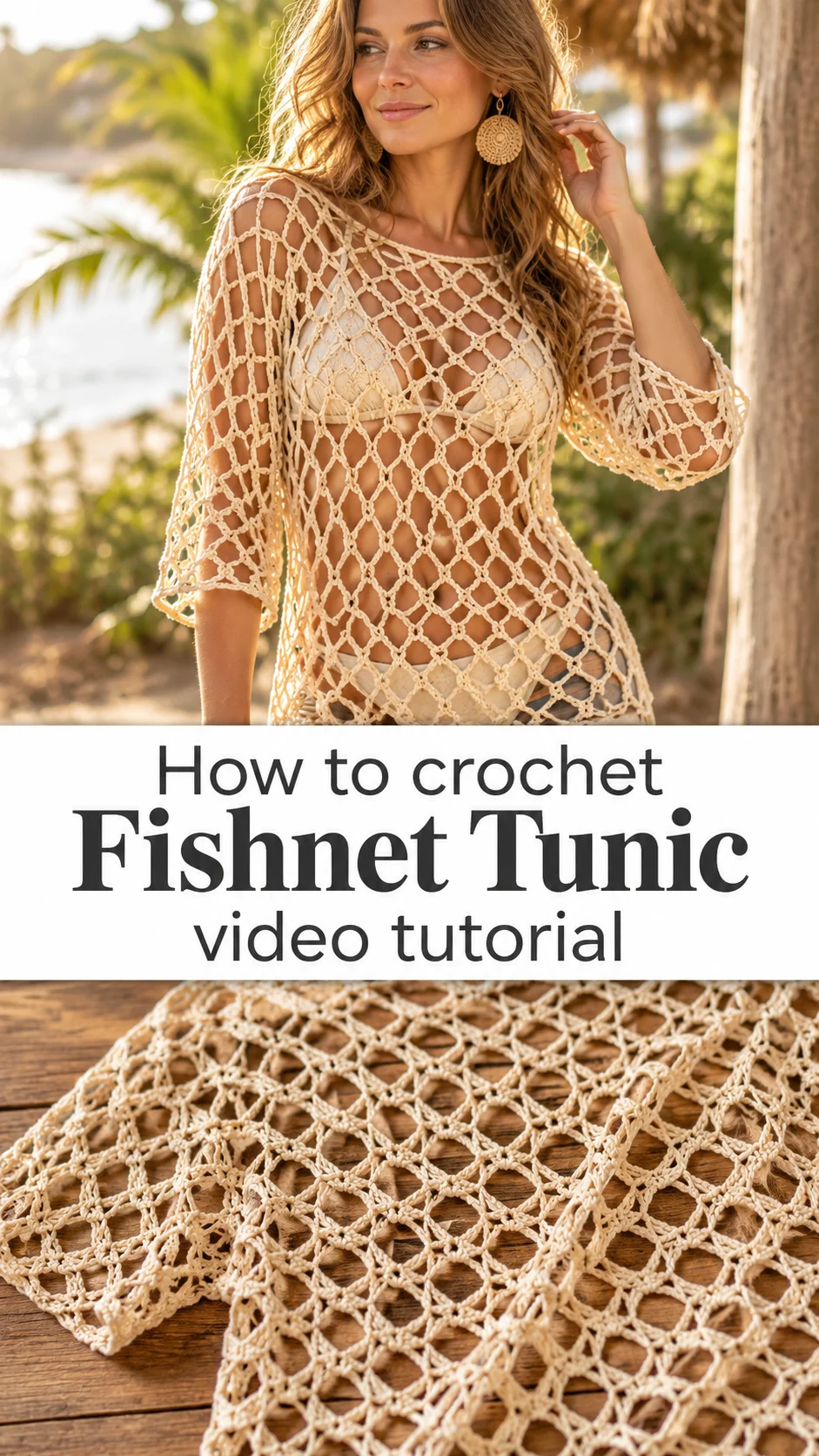
The Crochet Fishnet Tunic
This crochet fishnet tunic is built from an airy lattice of long chain arches, broken up by small blocks of tightly worked stitches. The blocks sit in staggered positions, so the eye reads the fabric as a diamond net rather than a plain grid. The yarn is a fine, smooth thread in a warm cream, close to ecru, with a soft sheen. Each block looks like a short ladder of stacked stitches, crisp against the open spaces around it. The result is a fabric that drapes easily and lets air pass through. It suits beach days, garden lunches and warm evenings. Layered over a slip or a simple tank, it feels relaxed and quietly polished at the same time.
Because the mesh is so open, the colour underneath becomes part of the design. Worn over white, the cream thread turns soft and lacy. Over a dark camisole, the pattern stands out in bold relief. The same fabric can also become a shawl, a table runner or a panel for a summer top. Short fragments of ease, then. Nothing heavy.
Fishnet Tunic Related Posts:
- Crochet Basket Weave Scarf: A Timeless Textured Classic
- Crochet Granny Square Pouches: A Charming Handmade Trio
- Crochet Lace Beret: A Chic and Delicate Accent
- Crochet Baby Blanket: A Soft and Timeless Treasure
Materials
A crochet fishnet tunic depends on thread-weight yarn, so look for a fine mercerized cotton or a smooth cotton blend in cream or ecru. Mercerized cotton holds its stitch definition and keeps a gentle gloss, which is what makes the small blocks stand out against the chain arches. Pair it with a small steel or aluminium hook, roughly in the 1.5 to 2.5 mm range, and adjust until the arches hang open without sagging. A hook that is too large makes the mesh floppy and shapeless, while one that is too small stiffens the drape. You will also need a tapestry needle for weaving in ends, a tape measure for checking the length as you go, and pins for blocking. Wool or fuzzy yarn is best avoided, because the halo of fibres would blur the clean lines of the net.
Understanding the Mesh Structure
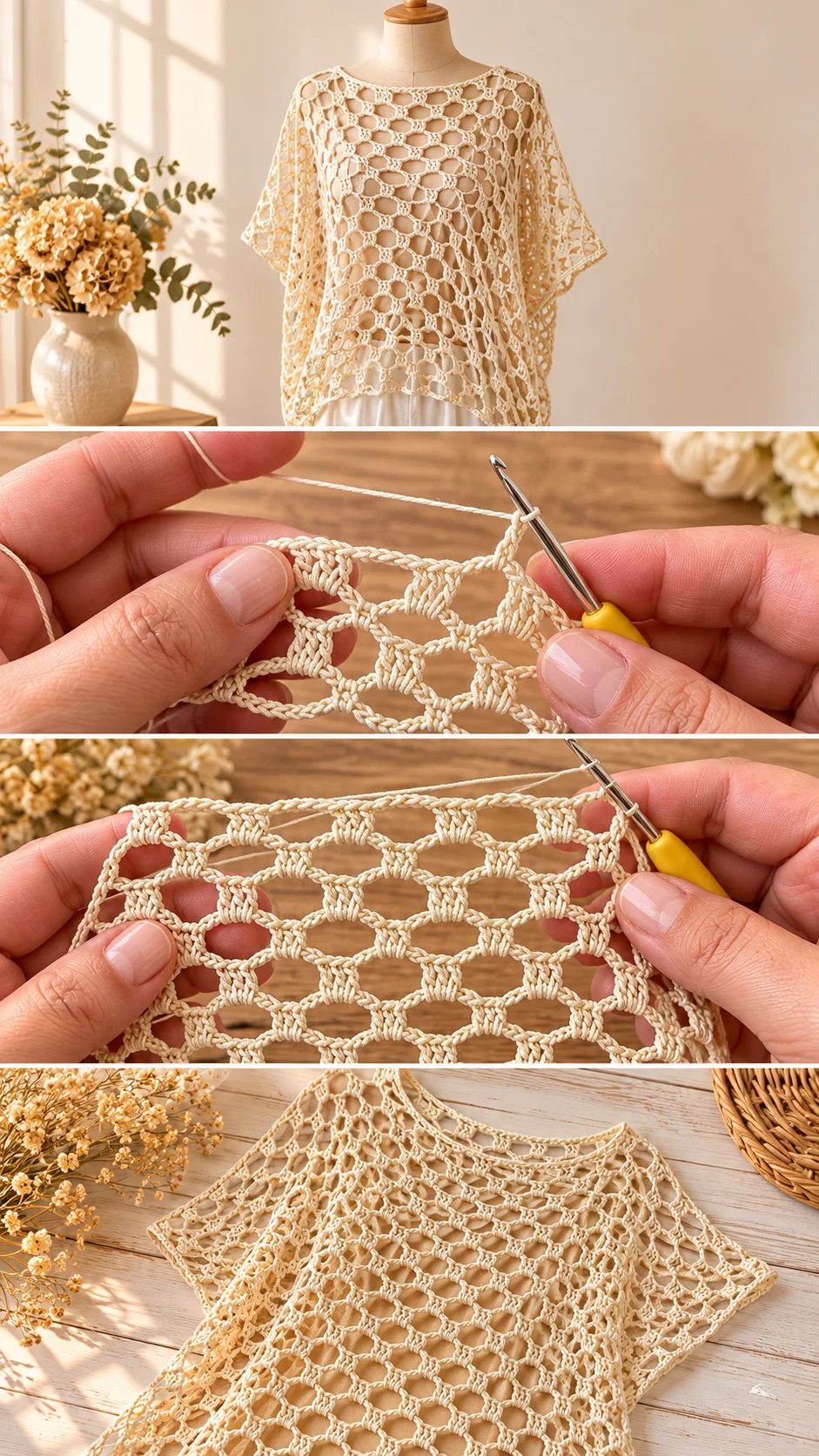
The fabric is worked from long chain loops anchored by single crochet, which gives the airy, net-like spaces. At regular points, small blocks of upright stitches break the chain arches, creating the diamond rhythm you see across the piece.
The tutorial’s on-screen note refers to a long chain followed by a single crochet, alternating with a shorter chain and single crochet. That alternation is what gives the pattern its two sizes of opening, one wide and one narrow. Watch how the hook returns to the same anchor points row after row.
Rows run straight across, so the swatch behaves like a rectangle with slightly wavy edges. That makes the stitch easy to adapt into panels for a tunic body. Two matching rectangles joined at the shoulders and sides is a natural route to a simple silhouette.
Pause the video each time a block is formed. The stitches in each block sit close together, and their height should match the chain arches on either side. If your blocks look shorter than the arches, the stitch is being pulled too tight.
Signature Detail: The Staggered Blocks
The small ladder-like blocks are what make this fabric special. They sit in alternating positions from row to row, so the diamonds seem to float across the surface instead of lining up in columns.
The choice you face is how firm to make them. Worked snugly, the blocks look sharp and structured, almost like tiny woven bars. Worked loosely, they relax into the arches and the pattern loses its definition.
The common mistake is to drift off position. If a block lands directly above the one beneath it, the staggered effect disappears and the net turns into plain stripes. Count the arches at the end of every row and compare them to the row below.
If the fabric ripples at the edges, the chain arches are probably being worked at different lengths. Keep your chain loops consistent by holding the working thread at the same tension each time. A relaxed grip on the hook helps too.
Choosing the Best Yarn for Drape
Mesh like this lives or dies by its drape. A mercerized cotton gives crisp stitches and a subtle glow, and it launders well. A cotton and viscose blend drapes even more fluidly, though it can stretch in length once the tunic is worn, so check the hang before committing to a full garment.
Linen thread is a third option. It begins stiff but softens with every wash, and its natural texture adds a rustic note. The trade-off is that linen can feel rough on the fingers during long sessions of work.
Avoid acrylic. It tends to spring back and feel warm against the skin, which defeats the purpose of an open summer fabric. It also resists blocking, so the arches will never settle into their intended shape.
For colour, the original cream is hard to beat, but soft sand, pale sage, dusty blue and white all carry the net well. Deeper shades like navy or black make the pattern look sharper and more graphic.
Shaping a Tunic from a Flat Panel
The swatch is a flat rectangle, and that is the key to turning it into a tunic. Two rectangles, one for the front and one for the back, can be joined along the shoulders and sides, leaving openings for the neck and arms.
Measure before you begin. Wrap a tape around the fullest part of the bust or hip, add the amount of ease you like, and divide by two for the width of each panel. For a relaxed tunic, a little extra width lets the mesh fall in soft folds rather than stretching across the body.
Work a generous swatch first and block it, then measure. Open mesh grows once it is wet and pinned, and the final size can differ noticeably from the unblocked piece. Plan the panel size from the blocked swatch, not the raw one.
For a neckline, leave a gap between the shoulder seams rather than shaping it row by row. That keeps the stitch repeat intact and avoids awkward partial blocks near the opening.
How to Style a Crochet Fishnet Tunic
Over a fitted white tank and denim shorts, the tunic becomes an easy beach cover-up. The cream thread glows against sun-warmed skin. Add flat sandals and a straw hat and the look is complete.
For evenings, wear it over a slip dress in champagne or navy. The open mesh lets the colour underneath show through, and the long chain arches catch the light. A slim belt at the waist gives shape without hiding the pattern.
It also works as a layering piece in cooler weather. Over a thin long-sleeved top and linen trousers, the net adds texture without weight. Choose a base colour that contrasts gently with the cream so the diamonds remain visible.
Tips for Neat, Even Mesh
Weave in ends along the blocks rather than through the chain arches. The stacked stitches give the needle something solid to hide in, and the tails will not show through the open spaces.
Block the finished piece by pinning it flat and misting or soaking it, then letting it dry fully. Blocking opens the arches and evens out any small differences in tension. If the arches look uneven after drying, repin and re-wet that area.
If the fabric feels stiff after blocking, rinse it again with a little fabric softener and let it dry on a flat surface. If it feels too loose, a gentler hook size on the next piece will help. Keep notes on the hook and thread you used.
Caring for Your Tunic
Hand wash in cool water with a mild soap, pressing gently rather than wringing. Wringing stretches the long arches and can distort the diamond pattern. Roll the piece in a towel to remove excess water.
Dry it flat, reshaping the mesh with your fingers as it dries. Hanging a wet net garment pulls the length out of proportion. Store it folded, not on a hanger, to protect the shape of the arches.
A Light Handmade Classic
This crochet fishnet tunic is a study in contrast: long open arches against small, firm blocks, all in a smooth cream thread. It is gentle to wear and satisfying to make once the rhythm settles in.
Four things decide how it turns out. Choose a fine, smooth thread. Keep your chain arches even. Stagger the blocks faithfully from row to row. Block the finished piece with care.
Open mesh, steady hands, a summer to wear it.
Video tutorial credit: thanks to the creator of the original crochet tutorial for this crochet fishnet tunic stitch pattern.
Follow us on Pinterest and subscribe to the Newsletter so you don’t miss a thing!
Tutorial and photos of this fishnet tunic by: Crochet Knitting Therapy .