
The crochet lattice stitch builds soft puffed blocks that sit between airy chain loops, so the fabric feels light, open and gently sculpted under your fingers.
The Crochet Lattice Stitch
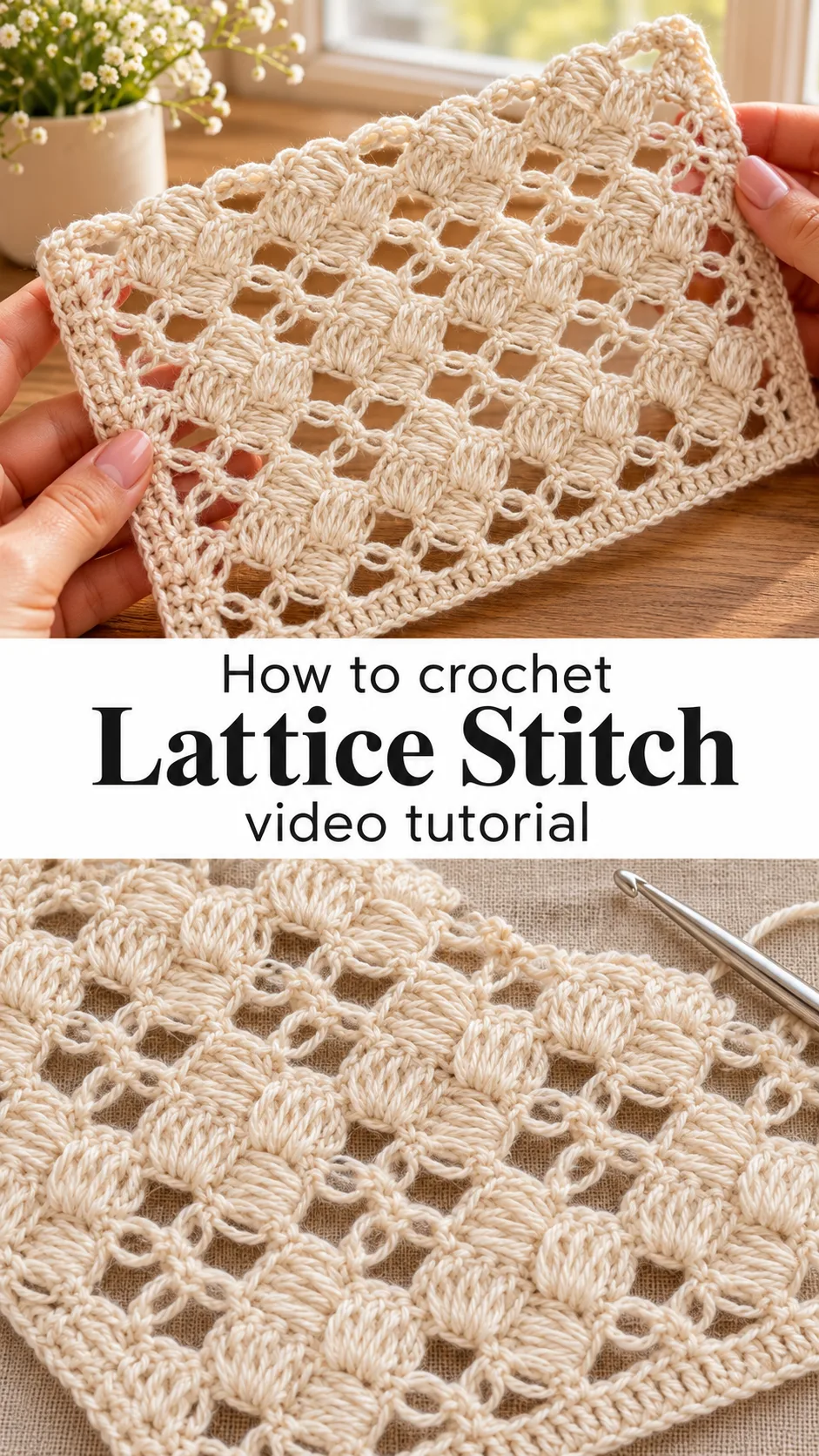
The crochet lattice stitch is a stitch pattern made of plump puff clusters and open chain loops that meet in a diagonal grid. Rows of puffs step across the fabric in staggered blocks, and the spaces between them show the background like small windows. The yarn in the sample is a fuzzy, pale oatmeal-grey with a slight brushed halo, which softens every loop. A neat band of dense single crochet runs along the bottom edge and frames the open work. This is a stitch for shawls, wraps, light scarves and summer tops. It looks intricate, yet the repeat is easy to learn once the rhythm settles into your hands.
Beyond a single project, this stitch is a handy one to keep in your repertoire. It makes a graceful gift because the texture reads as special while the work stays manageable. It also teaches useful skills: even puff tension, counting chain spaces and keeping an edge straight. Worth a swatch.
Lattice Stitch Related Posts:
- Crochet Granny Square Handbag: A Charming Vintage Accent
- Crochet Reversible Cardigan: A Chic Versatile Wrap
- Crochet Amber Pocket Scarf: A Warm and Cozy Wrap
- Crochet Rose Appliqué: A Delicate Floral Accent
Materials
For a crochet lattice stitch swatch or project, choose a smooth, lightly fuzzy yarn in a fine to light weight, such as a wool or acrylic blend with a touch of mohair or angora feel, like the soft grey-lilac skein shown with the sample. The puffs need a yarn that blooms slightly, because a slick, hard cotton will make them look flat and stiff. A small steel or aluminium hook in the 3 to 4 mm range is a sensible general starting point, but let your swatch decide. If the fabric feels like cardboard, move up half a size, and if the puffs gape, move down. A tapestry needle for weaving in ends and a pair of sharp scissors complete the kit. Pale, solid colours show the puff shadows best.
Understanding the Stitch Structure
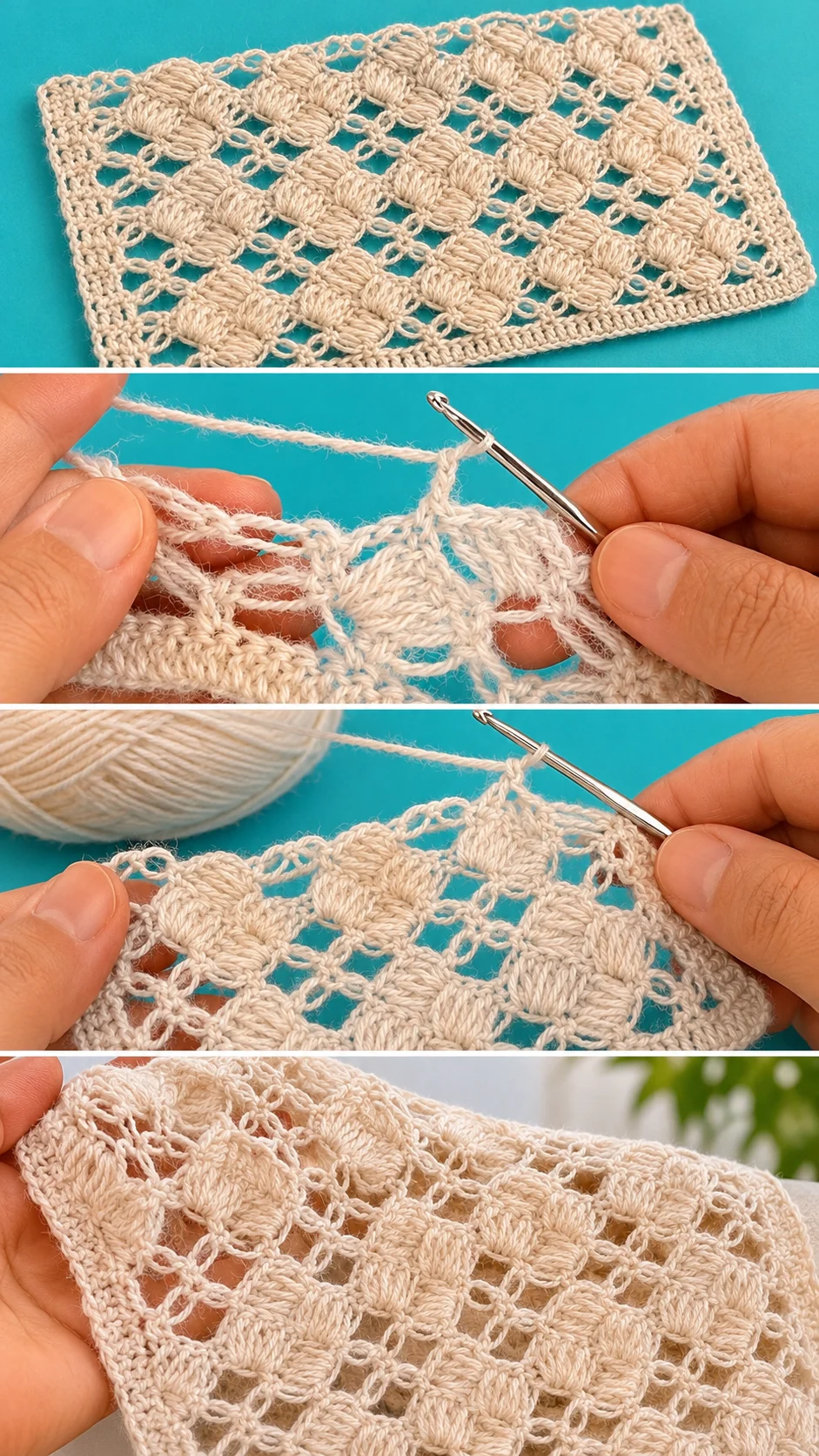
The fabric is built from two alternating elements. One is a pair of stacked puff stitches that form a rounded block, and the other is a set of chain loops that bridge the gaps. Each row places new blocks over the open spaces of the row below, which is what creates the diagonal, lattice-like movement.
The piece is worked flat in rows, with a foundation chain and a firm base row along the bottom edge. In the close-up of the third row, you can see the hook pulling up tall loops through a space, then closing them into a puff. The blocks sit snugly against each other, and the chain arches float above and below them.
Because each row nests into the previous one, the sample looks as if the puffs march upward in short diagonal bands. Keep that visual in mind as you work. When the bands drift out of line, you have almost certainly skipped or doubled a space.
The video shows the hook entering the chain space rather than the stitch itself. Pause there and replay it, as that detail controls the whole look of the fabric.
Puffs and Chain Loops: The Detail That Defines It
The puffs are the signature. In the sample they are round, full and slightly domed, with each one pressed close to its neighbour so the pair reads as one soft block. Their size depends on how loosely you pull up each loop. Pull the loops to the same height every time and the blocks will match.
The choice you face is how fat to make them. Taller loops give a pillowy, dramatic puff, but they also open larger holes and make the fabric stretch. Shorter loops give a tidier, flatter block and a firmer drape.
The chain loops need the opposite care. If they are pulled tight, the whole piece puckers and the windows shrink. If they are too loose, they sag and the grid loses its sharpness.
A common mistake is closing the puff too snugly, which squeezes the top and makes it look pinched. If that happens, relax your tension on the final pull-through and keep the working yarn loose in your hand.
Keeping the Edges Straight
The sides of the sample are neat and upright, which is not automatic with this stitch. Each row begins and ends with a short chain-and-stitch turn, and the way you treat that turn decides whether the edge stays clean. If the sides start to flare outward, you are probably adding an extra loop at the turn. If they pull inward, you are likely missing the last space. Count your chain spaces at the end of every row for the first few rows, until the habit sticks.
Best Yarns for a Lightly Textured Lace
A soft wool-blend or acrylic-blend yarn with a gentle halo, as in the sample, gives the most flattering result. The fuzz blurs the stitch edges slightly and makes the open spaces feel dreamy rather than harsh. It also adds a little cling, which helps the puffs hold their shape.
A mercerised cotton or a bamboo blend suits warm weather. It makes the grid crisper and the fabric cooler, though the puffs will be a little less plush. Use a hook half a size smaller to keep the blocks from looking limp.
Avoid very slippery or splitty yarns. Slick rayon or loosely plied novelty yarn can snag in the multiple loops the puff requires, and splitting strands make a puff look ragged. A tightly spun, smooth yarn is also unkind to this stitch, because the loops will not blend into a soft cluster.
For colour, the oatmeal-lilac grey in the sample is a calm choice that shows the shadow play. Dusty rose, soft sage, cream and pale denim blue are good alternatives. Dark colours hide the texture, so save them for a bolder, thicker yarn.
Projects That Suit the Stitch
Because the fabric is open and light, it drapes beautifully as a shawl or a long rectangular wrap. The staggered blocks create a natural diagonal flow, which looks elegant draped over the shoulders. The base edge in the sample, a firm band of single crochet, shows how a border can anchor the lace and keep it from stretching.
A scarf is the easiest first project. A narrow strip needs only a handful of repeats across, so the rhythm is learned quickly and the result is wearable in an evening or two of work.
The stitch also works for a summer top panel, a table runner or a lightweight throw. For a garment, make a swatch first and wash it, because open puff fabric can grow in length once it is wet or worn.
How to Style a Crochet Lattice Stitch Piece
Start with the look in the sample: soft grey-lilac, light and airy. Worn as a wrap, it adds a gentle layer over a plain tee or a fitted knit without hiding what is underneath. The windows let a contrasting colour peek through.
For evening, drape a longer piece over a black slip dress or a simple satin blouse. The fuzzy puffs add warmth and texture against smooth fabrics.
For daytime, loop a scarf once around the neck over a denim jacket, or wear a shawl over a linen shirt with the corners tied loosely at the front. Pale neutrals pair well with almost any wardrobe.
As a gift, wrap the finished piece in tissue and tuck in a note about washing. A stitch with this much visible depth always looks more complicated than it was to make.
Finishing Tips for a Polished Fabric
Weave in ends along the dense edge band or through the base of a puff block, never across an open window, where a stray tail will show. Split the yarn ends with the needle and weave them back and forth for a secure hold.
Block the piece. Open puff lace relaxes and becomes more even when pinned out damp, and the chain loops open into a clearer grid. Use a gentle steam or a wet block, and let it dry flat.
If the fabric feels stiff, your hook was probably too small, so try going up a half size on the next attempt. If the puffs look uneven, check that you are pulling each loop to the same height, and use your finger as a gauge. If the work curls at the sides, a firm edge band or a gentle block usually calms it.
Care is simple. Hand wash in cool water with a mild soap, press out the water in a towel without wringing and dry flat. Hanging a wet piece will stretch the open spaces and the puffs will lose their bounce.
A Soft Handmade Classic
The crochet lattice stitch rewards patience with a fabric that is light, textured and quietly impressive. Its puffs and open loops sit together in a rhythm that is easy to learn and hard to forget.
Four things decide how it turns out: a soft, lightly fuzzy yarn, even puff tension, relaxed chain loops and a clean edge turn. Swatch first, block gently and let the grid open up.
Small stitch, lasting charm.
Follow us on Pinterest and subscribe to the Newsletter so you don’t miss a thing!
Tutorial and photos of this lattice stitch by: Crochet Knitting Sort.