
Learn to crochet lisianthus roses and bring their ruffled, layered grace into your home, your gifts, and your hands. These blooms translate beautifully into a handmade bouquet, a forever centerpiece, or a soft and romantic gift for someone you love.
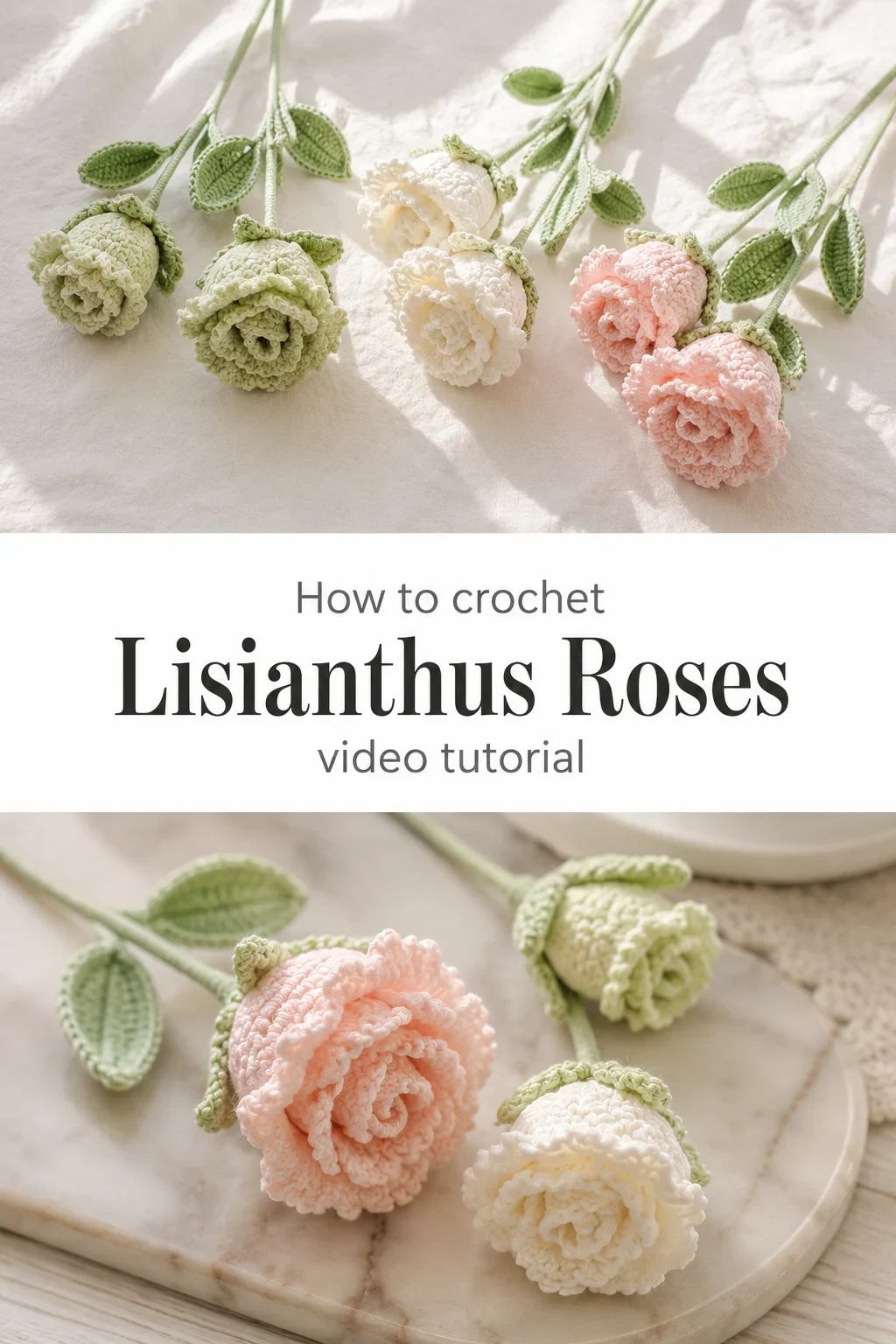
The Lisianthus Roses
Crochet lisianthus roses carry a quiet sophistication that feels both familiar and rare, the kind of bloom that stops you mid-step at a florist’s window. Their layered petals spiral outward in a way that is airy yet structured, holding a gentle tension between openness and enclosure. This pattern is designed for crafters who love texture and dimension, who want to make something that looks too beautiful to be yarn. Whether you are new to floral crochet or already comfortable with working in the round, these blooms will meet you with patience and reward you generously.
Lisianthus Roses Related Posts:
- Crochet Wooden Handle Bag: A Gorgeous Handmade Accessory
- Crochet Cozy Slipper Socks: A Warm Everyday Essential
- Crochet Lace Motif: A Delicate Floral Masterpiece
- Crochet Rose Bouquet: A Beautiful Floral Arrangement
The color palette shown in the reference images speaks in the softest voice possible: sage green, blush pink, and warm cream, arranged together like a watercolor exhale. You could lean into that romantic trio, or choose a single color for a monochrome display that feels modern and sculptural. A deeper dusty rose or a muted terracotta would shift the whole mood toward autumn warmth, while a pale lavender makes them feel almost bridal.
Materials and Tools
To achieve that lush, textured surface that makes crochet lisianthus roses look so convincingly petal-soft, reach for a DK weight yarn in a chenille or boucle blend. The slight fuzziness of chenille blurs the stitch definition just enough to mimic the velvety feel of real lisianthus petals, while still holding the shape of the flower beautifully. A 3.5mm crochet hook, as used in the video tutorial, gives you firm control over the petals without pulling the yarn too tight. You will also want a yarn needle for weaving ends, and a length of floral wire or pipe cleaner inside each stem to keep the flowers poseable and upright.
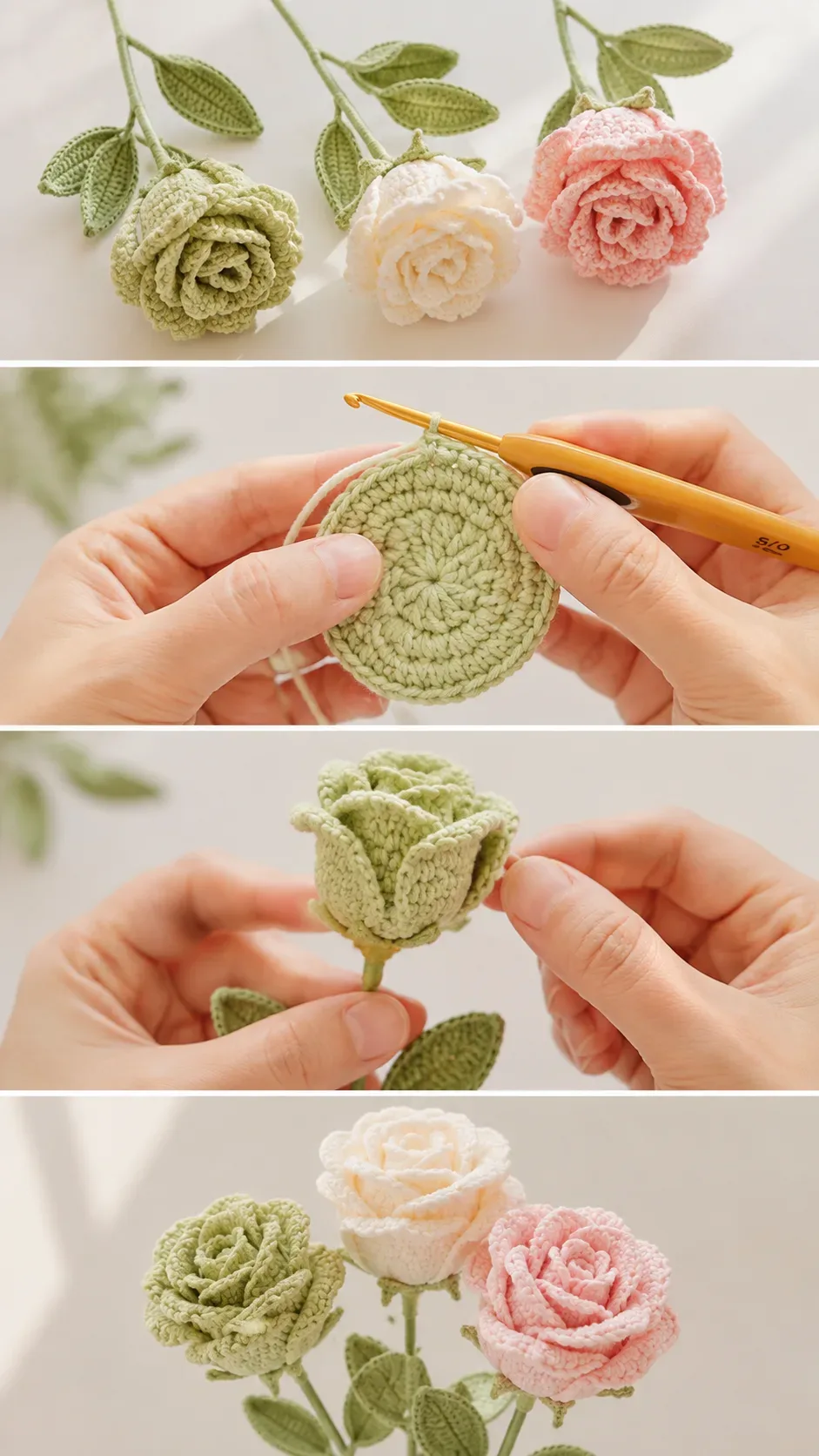
Stitch by Stitch
The construction of crochet lisianthus roses draws on a core set of stitches that build from simple to satisfying.
BULLET:SC (Single Crochet) The foundational stitch used throughout the stem and leaves, creating a dense, smooth fabric that holds its form.
BULLET:DC (Double Crochet) Adds height and fluid movement to the petal sections, giving each layer that characteristic open, ruffled edge.
BULLET:Magic Ring (MR) The starting point for each circular petal disc, allowing you to close the center completely without any unwanted gap.
BULLET:Slip Stitch (SL ST) Used to join rounds seamlessly and to create the defined ridges that give the sepals and stem their structured, botanical texture.
Working through these stitches falls into a meditative rhythm very quickly, especially during the petal rounds, where the repeated DC clusters feel like a small ritual of making. Each round completed is a petal born, and that progress is immediate and deeply satisfying.
Construction
The crochet lisianthus roses are built from several separate components: a circular petal base worked in the round, individual petal layers that are crocheted flat and then curved around the center, and elongated leaves worked back and forth in rows along the stem. The video tutorial walks through each component in clear sequence, making it approachable even if floral crochet is new to you. The stem is worked as a tight SC tube over a wire core, which keeps everything upright and shapeable once assembled. For a customisation idea, try working two petal layers instead of three for a more closed bud effect, like the smaller blooms visible in the reference images.
Wearing Your Lisianthus Roses
A finished stem of crochet lisianthus roses placed in a simple glass vase becomes the kind of thing guests ask about before they ask about anything else. Group three stems in graduating heights and wrap them in kraft paper for a handmade gift that will last far longer than any real bouquet. You could also tuck a single bloom into a wrapped gift, pin it to a tote bag, or use a small bud as a bookmark that stays in place with a clip.
Keeping Your Crochet Lisianthus Roses Looking Their Best
Because these flowers are decorative rather than wearable, they are unlikely to need frequent washing, but the chenille yarn does attract dust over time. A gentle puff of compressed air or a soft dry brush is usually enough to refresh the blooms without disturbing their shape. If a flower needs a more thorough clean, hand wash it carefully in cool water with a drop of wool wash, reshape it while damp, and allow it to air dry flat away from direct sunlight. Store finished blooms upright in a vase or loosely wrapped in tissue inside a box so the petals do not get pressed flat.
Every set of crochet lisianthus roses you finish is a small act of making something enduring out of something as simple as yarn and a hook, and that is worth celebrating. Save this article to your crochet Pinterest board and share your finished blooms with the handmade community so others can find their way to this pattern too.
Follow us on Pinterest and subscribe to the Newsletter so you don’t miss a thing!
Tutorial and photos of this lisianthus roses by: 小师妹手作.