
A crochet floral square motif turns a few rounds of pink and teal into a four-petal bloom that sits neatly inside a square. It feels calm to make, with one colour change after another building a graphic flower you can join into endless fabric.
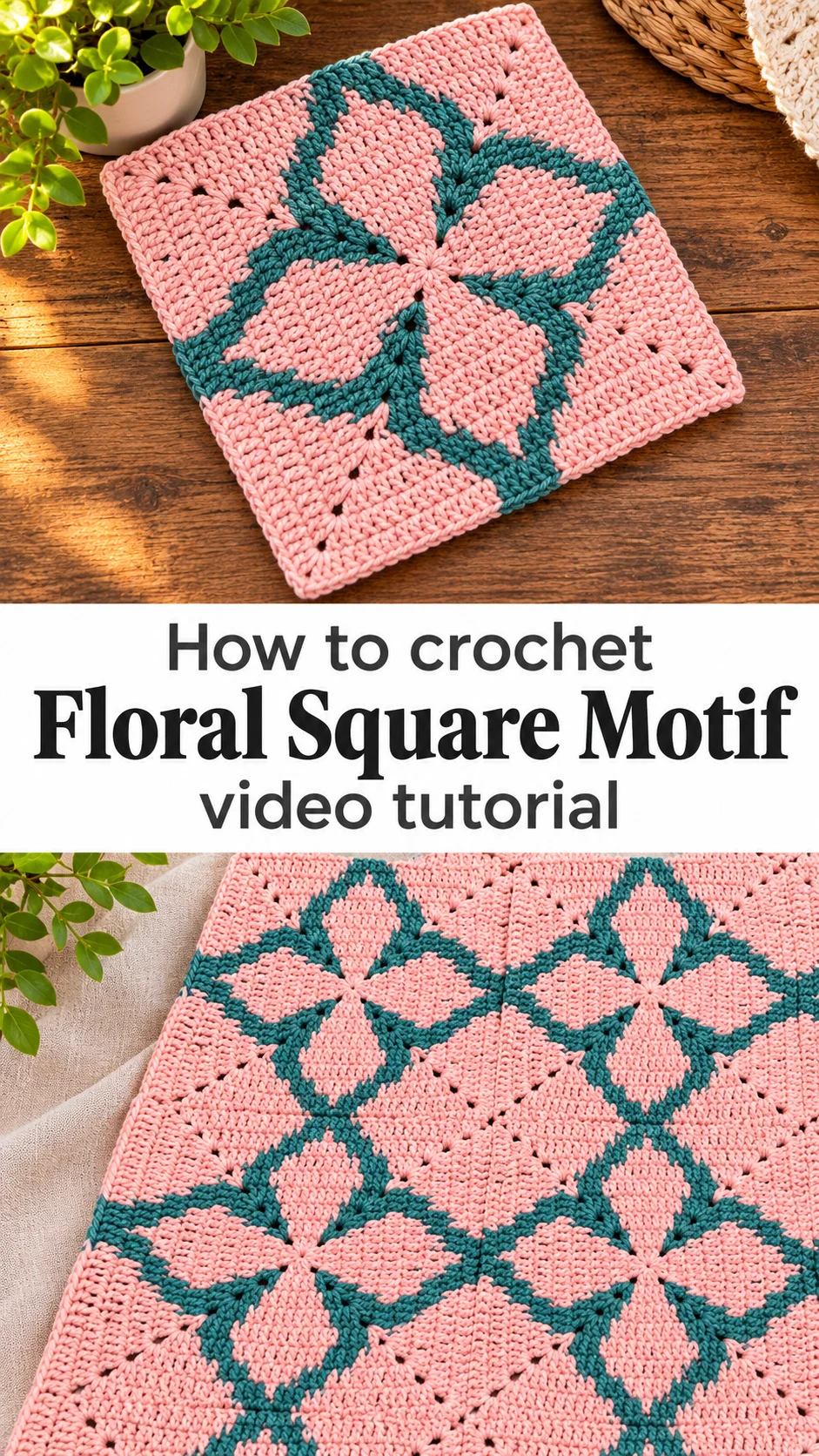
The Crochet Floral Square Motif
The crochet floral square motif is a flat granny-style square with a flower drawn in contrast colour. Soft salmon pink fills the petals and the background, while a deep teal line outlines each petal and curls into pointed tips near the centre. The rows radiate from a small centre, and the four corners carry the classic open holes of a granny square. The fabric looks dense and firm, with raised clusters in the petals and tidy edges all round. What sets it apart is how the teal lines continue from one square to the next when the motifs are joined, forming a lattice of diamonds and blooms. It suits cushions, blankets, bags and wall pieces.
One square is a pleasant small project. Many squares become a throw where the flowers appear to grow across the whole surface. It makes a thoughtful gift for a friend who loves botanical prints, and it teaches colour changes in a forgiving, repeating shape.
Square Motif Related Posts:
- Crochet Shoulder Bag: A Chic and Versatile Accessory
- Crochet Shoulder Bag: A Chic and Breezy Accessory
- Crochet Baby Blanket: A Soft and Timeless Treasure
- Crochet Throw Pillow: A Warm and Timeless accent
Materials
For a crochet floral square motif like this, choose a smooth, matte cotton or cotton blend in two colours: a dusty salmon pink for the main field and a muted teal for the outline. The stitches in the photos look sharp and well defined, which points to a yarn with a tight twist and little fuzz. A DK or light worsted weight is a sensible starting point, paired with a hook of about 3.5 to 4 mm, though the yarn label and your own tension should decide. A small metal hook such as the golden one in the tutorial glides well through dense clusters. You will also need scissors and a tapestry needle for weaving in ends, since the colour changes leave several tails. If you plan to join many squares, buy all the yarn for the project at once, because dye lots in pastel pinks can vary noticeably.
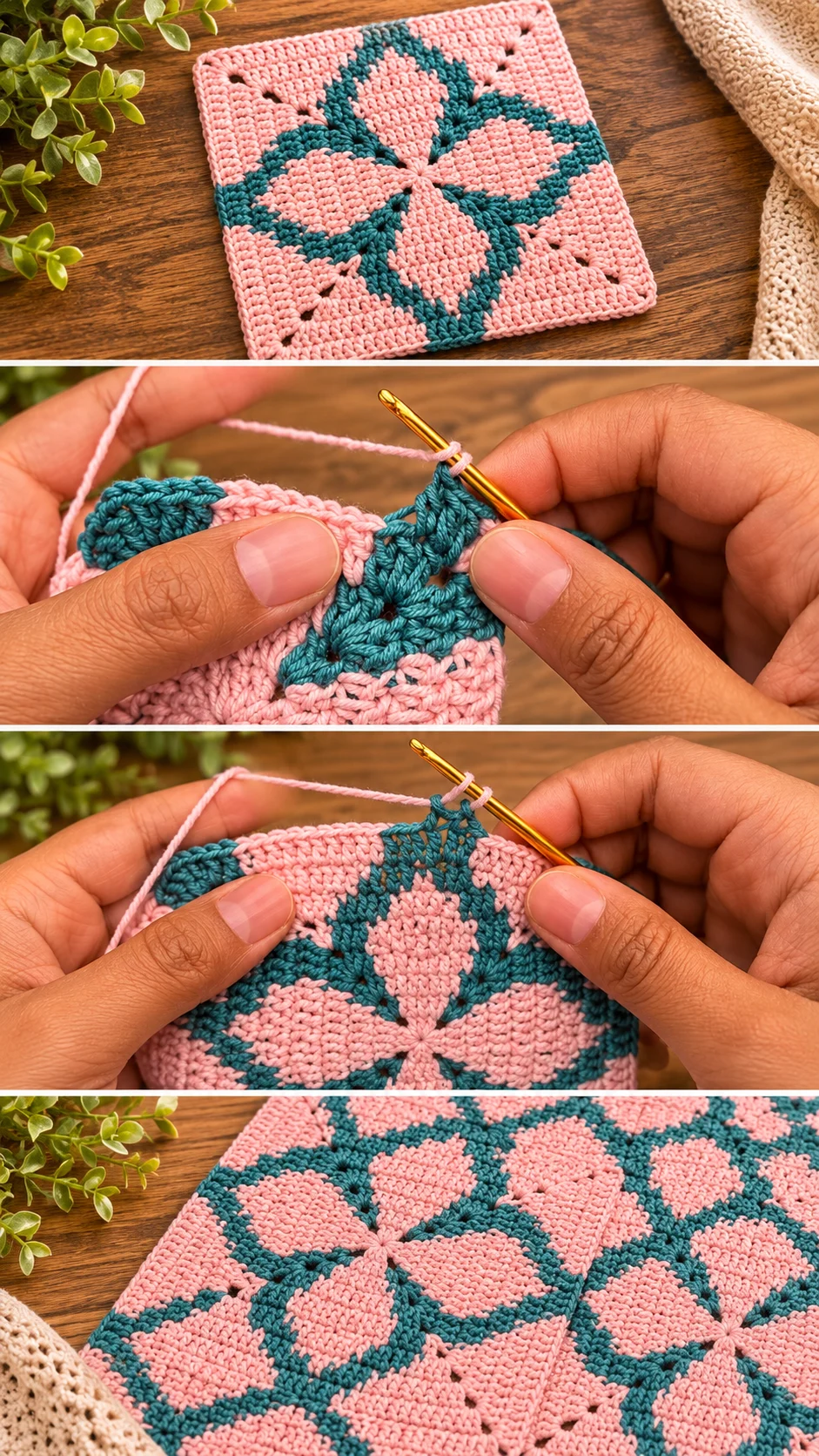
Understanding the Square’s Construction
The square is worked from the centre outward in the round, with the four petals radiating from a tiny middle point. Each round grows the petals while the corners gain their open spaces, so the shape stays square rather than turning round.
The pattern is an example of tapestry-style colour work. Teal is used where the outline sits and pink everywhere else. The carried yarn is not visible on the front, which suggests the unused colour is either carried along the back or trimmed and picked up again.
The outer rounds look different from the flower. Around the petals, the pink forms a plain frame of closely packed stitches, with a few teal flecks showing along the very edge. That frame is what makes the squares easy to join and keeps the flower from touching the border.
Because the design is built from the middle, mistakes near the centre travel outward. Check that all four petals are growing at the same pace before you move on.
Colour Changes That Stay Clean
The teal outline is only a few stitches wide, so every change matters. Switch colours during the final yarn-over of the last stitch before the change, so the new colour sits fully in the new stitch and no pink peeks through.
Keep the carried strand loose enough to lie flat but not so slack that it snags. If the fabric puckers where the teal runs, your carried yarn is too tight. If you see loops on the back, it is too loose.
Watch how the creator moves between colours in the video. Pause at the moment of a change and replay it until your hands copy the same rhythm.
Best Yarn and Colour Choices for a Crisp Floral Square
Cotton gives the sharpest outline. It has little stretch, so the teal line stays clear and the petals keep their shape. A cotton and acrylic blend is slightly softer and more forgiving on the hands, which helps during long joining sessions. Avoid fuzzy or brushed yarns, because the halo blurs the edge where teal meets pink and the flower loses definition.
The pink and teal pairing works because the two colours differ in depth. Any combination with that same contrast will read well. Try cream with navy for a classic look, butter yellow with sage for a spring feel, or charcoal with blush for something more modern.
If two colours are close in value, the petals will look muddy. Hold both skeins together and squint. If you can still tell them apart, the flower will show clearly once stitched.
Skill Level and the Patient Part
This square suits a confident beginner who already handles double crochet and basic colour changes. The stitches themselves are simple, with clusters and doubles making up most of the fabric. The skill lies in tracking where each colour begins and ends.
The patient part is the middle rounds, where the petals widen and the teal lines curve. Counting stitches carefully before each colour change prevents the outline from drifting off its path. Place a small marker at each petal tip if you lose your place easily.
If the square starts to cup or ruffle, the stitch count has likely crept up in one round. Pull back to the last correct round rather than hoping blocking will fix it.
How to Style a Crochet Floral Square Motif
On its own, one square works as a coaster, a pot-stand or a small cushion front. Pink and teal sit well against a warm wood table, as the setup in the photos suggests.
Joined in a grid, the squares form a throw where the teal lines link into diamonds across the surface. Draped over a cream sofa, it adds a gentle, vintage-garden note without overwhelming the room.
Try sewing four or six squares into a tote bag, adding a lining for strength. A single square also frames nicely on a wall or sits sewn to a plain linen pillow.
For gifts, a set of four squares tied with ribbon makes a coaster set. Choose colours to match the recipient’s kitchen or living room.
Tips for Neat Joining and Finishing
Weave in the ends as you go, or at least after each square. A dozen squares with a dozen tails each is a long evening of finishing. Weave the teal tails into teal areas and the pink into pink so no dark strand shows through the light stitches.
Block each square before joining. Pin it to a flat surface, mist lightly with water and let it dry. This evens out the stitches and makes the corners meet cleanly, which matters when the teal lines must connect across seams.
Join the squares with a flat method, such as whip stitch or slip stitch through the back loops, so the seam does not add a ridge. Pink thread works for most seams and disappears into the borders.
If the teal lines do not quite align across two squares, check whether one square is slightly larger. Gentle blocking can often fix a small difference, but a noticeably bigger square is better redone.
Caring for Your Floral Squares
Cotton and cotton blends usually tolerate a gentle machine wash, but check your yarn label first. Wash with similar colours, since a deep teal can release dye in the first few washes. Adding a colour catcher sheet gives pink areas extra protection.
Dry flat, reshaping the piece while it is damp. Hanging a heavy, joined blanket stretches the stitches and pulls the squares out of line.
A Handmade Garden in Squares
The crochet floral square motif rewards patience with a bold, graphic bloom and a border that joins neatly to its neighbours. It works as a single coaster or as the first of many in a blanket.
Four things decide how it turns out: a smooth, matte yarn, two colours with real contrast, clean colour changes and careful blocking before joining. Get those right and each square will look crisp.
Pick up your hook and make just one.
Video tutorial credit: this square is taught step by step by its original creator in the video below, which is well worth following closely and pausing often.
Follow us on Pinterest and subscribe to the Newsletter so you don’t miss a thing!
Tutorial and photos of this floral square motif by: Knitting time🧶by Dina.