Crocheting a garment can feel intimidating. All those pieces, the seaming, the worry about fit. But here’s the truth: this vest is far more approachable than it looks.
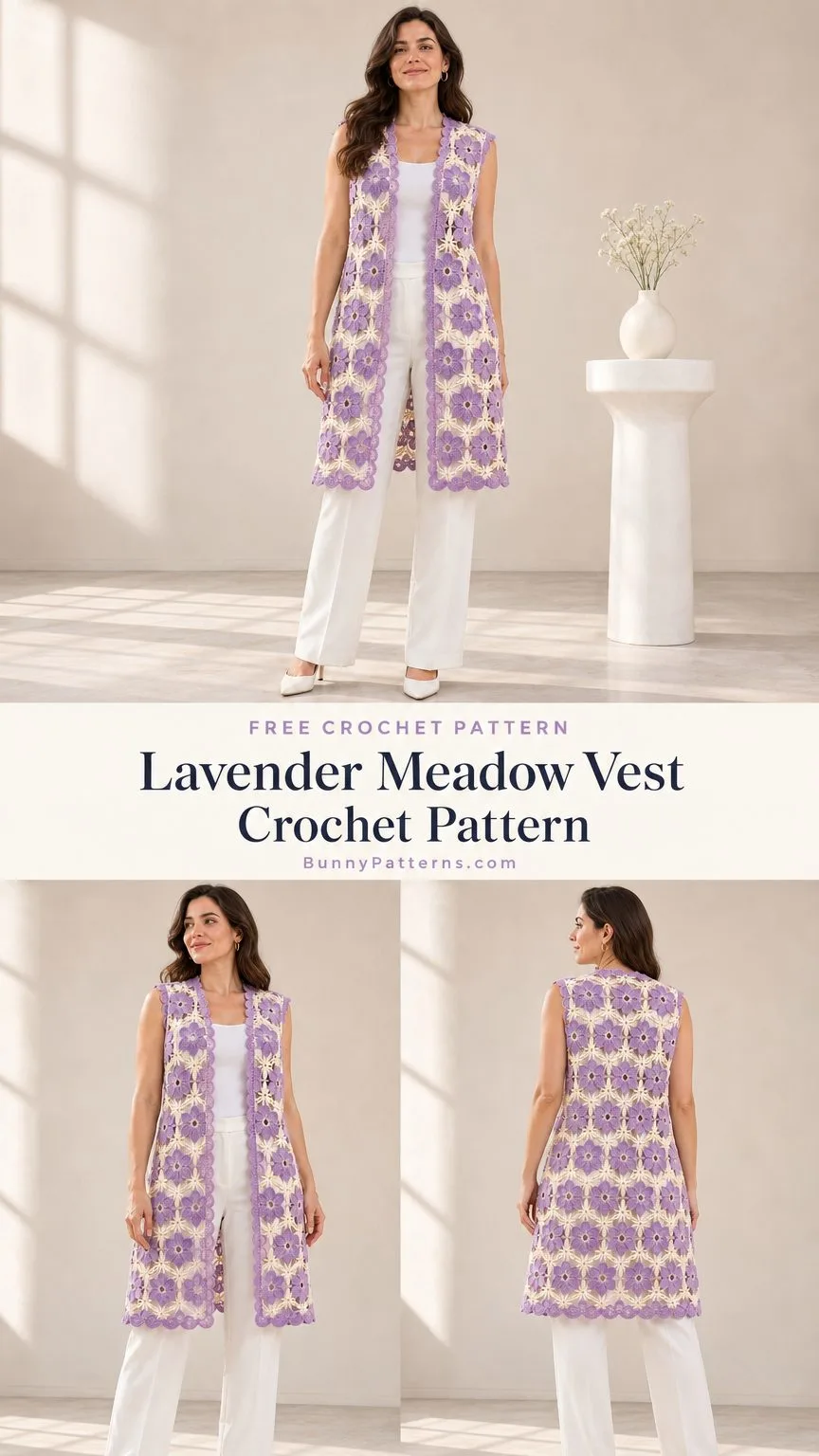
The Lavender Meadow Vest uses a clever construction method that takes the guesswork out of sizing. You’ll work simple mesh panels first, which give you a stable, predictable foundation. Then you sew beautiful flower motifs onto the mesh. No joining-as-you-go stress, no counting picots while simultaneously attaching to the previous motif. The mesh does the structural work, and the flowers are purely decorative.
Whether you’ve never made a garment before or you’re a seasoned crocheter who wants a relaxing project, this pattern breaks everything down into manageable steps. The result? A stunning, long, open-front vest covered in lavender blooms and delicate ivory star connectors. It looks like heirloom lace. It works up like a beginner-friendly project with pretty motifs.
About This Design
This sleeveless vest measures approximately 90 cm in length, making it a dramatic, knee-length layering piece. The worked example fits an adult body with a 90 to 100 cm bust measurement. The garment features a 100 cm fabric span around the body plus an approximately 8 cm open front, so it drapes beautifully over a simple tank top or blouse.
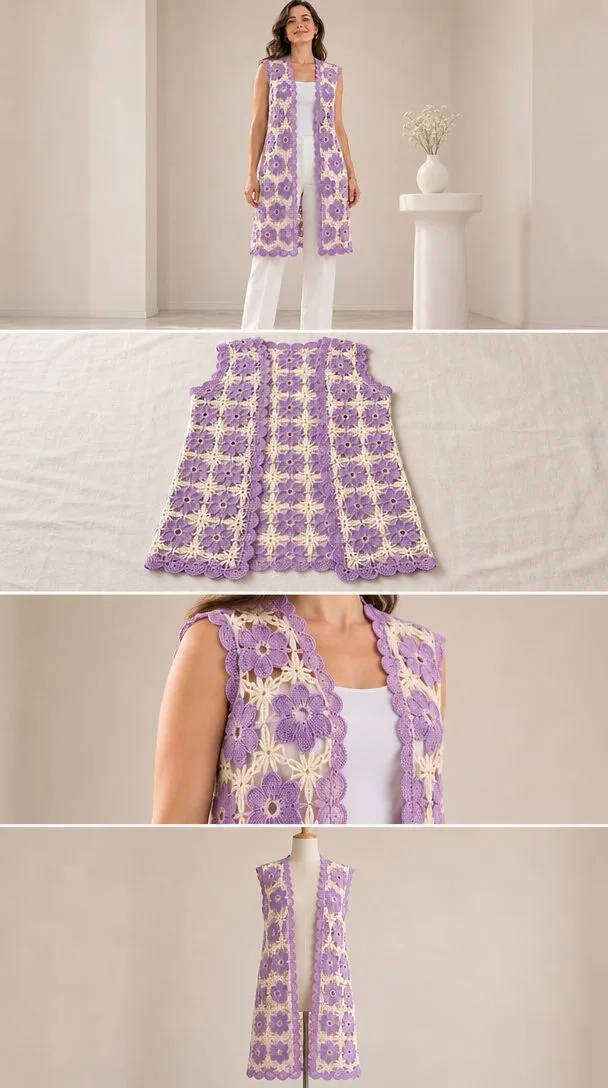
The design pairs an ivory square mesh lattice with lavender six-petal flower motifs and decorative star connectors. The mesh provides structure and ensures consistent sizing, while the flowers add texture, color, and that coveted handmade charm.
You’ll make three rectangular panels (one back, two fronts), join them at the shoulders and sides, then sew 64 flower motifs onto the lattice. Ivory star connectors fill the gaps between flowers. A scalloped border finishes the front edges, neckline, hem, and armholes.
Skill Level
Confident beginner to intermediate. You should be comfortable with basic stitches like single crochet (sc), double crochet (dc), and chains (ch). You’ll also work in the round for the motifs. The mesh fabric is repetitive and meditative, and the motifs are small enough to complete in one sitting.
Materials and Tools
Gather these supplies before you begin:
| Item | Details |
|---|---|
| Yarn | Sport weight cotton, 160 m per 50 g |
| Mesh (ivory) | 250 g |
| Motifs (lavender) | 200 g |
| Total yarn | 450 g / 1440 m |
| Hooks | 3.5 mm for mesh panels; 3 mm for motifs and edging |
| Notions | Tapestry needle, 12 stitch markers, measuring tape, blocking mat |
Tip: Weigh one blocked motif and multiply by 64 before purchasing all your yarn. If your 8 cm sample flower weighs over 2 g, add an extra 50 g to your lavender yarn order.
Gauge
Getting gauge matters for garment fit. Here’s what to aim for:
- Mesh: 8 square cells and 8 rows = 10 x 10 cm after washing and blocking
- Flower motif: approximately 8 cm across
- Cropped buttercup variation: 5 cm across
- Leaf variation: approximately 6 cm long
How to swatch: Work 16 cells by 16 rows in mesh, wash, and dry flat. Adjust your 3.5 mm hook up or down to match gauge. For motifs, make one flower and adjust only the 3 mm hook to reach the target diameter.
Important: The mesh is the structural garment. Your motifs must not pull the mesh smaller. If your flowers are too tight, go up a hook size for the motifs only.
Abbreviations and Special Stitches
Here’s every abbreviation you’ll encounter, with plain-English definitions:
- ch = chain
- sl st = slip stitch
- sc = single crochet (insert hook, yarn over, pull through, yarn over, pull through both loops)
- hdc = half double crochet
- dc = double crochet (yarn over, insert hook, yarn over, pull through, yarn over, pull through 2 loops, yarn over, pull through remaining 2 loops)
- tr = treble crochet
- st(s) = stitch(es)
- sp = space
- sk = skip
- rep = repeat
- RS/WS = right side/wrong side
- BLO = back loop only
- yo = yarn over
- rnd = round
Special Stitches
FPdc (Front Post double crochet): Work a dc around the post of the next stitch, inserting your hook from front to back to front.
BPdc (Back Post double crochet): Work a dc around the post, inserting from back to front to back.
FPtr (Front Post treble crochet): Work a tr around the indicated post from the front.
dc2tog (double crochet 2 together): Work 2 incomplete dc over the next 2 stitches (yarn over, insert, pull through, yarn over, pull through 2 loops, stop). Then yarn over and pull through all 3 loops on your hook. This decreases 2 stitches to 1.
Bobble: Work 5 incomplete dc in one stitch (stop before the final pull-through each time). Yarn over and draw through all 6 loops. Counts as 1 stitch.
Picot: Ch 3, sl st into first chain. Decorative only.
Mesh M(C): This creates your square lattice. Chain (2C+3). Double crochet in the fifth chain from hook. Ch 1, skip 1 chain, dc in next chain. Repeat from to a total of (C-1) times. This gives you C cells and C+1 posts.
For subsequent rows: Ch 4 (counts as first post plus ch-1), dc in next post, ch 1, dc in next post. Repeat across. Work the final post into the third chain of the previous turning ch-4.
Star connector: Ch 4, join into a ring with a sl st. Ch 4, sl st in ring. Repeat 8 times total. Fasten off. You’ll sew the spoke tips to the mesh at intersections between adjacent motifs. This is decorative, not load-bearing.
Pattern Notes
Read through the entire pattern before starting. All measurements are after washing and drying flat. Yarn amounts include approximately 15% allowance and are estimates.
Turning and joining rules:
- Turn after every flat row
- Ch 1 for sc/hdc rows and ch 2 for dc rows do NOT count as stitches
- Work the first stitch into the first stitch
- Mesh turning chains ARE a stated exception (the ch-4 counts as the first post plus ch-1)
- Joined rounds are not turned unless stated
- End every joined round with sl st to the first stitch; the join does not count
Brackets group a repeat. Stitch counts refer only to the active piece. Right and left refer to the wearer.
Construction Overview
You’ll work this vest in pieces, then assemble:
- Back panel: 50 cm wide x 90 cm long (40 cells)
- Two front panels: Each 25 cm wide x 90 cm long (20 cells)
- Shoulder seams: 12 cells / 15 cm each
- Neck gap at back: 16 cells / 20 cm
- Armhole depth: 20 cm / 16 row ends left open on each side
- Motif layout: 8 horizontal rows of flowers (4 across the back, 2 on each front)
- Total motifs: 64 flowers
- Star connectors: 35
Instructions
Back Panel
Row 1: Make M(40). [40 cells / 41 posts]
Rows 2 through 72: Repeat the mesh row. [40 cells / 41 posts]
Block to 50 x 90 cm. Mark the outer 12 cells at each top corner for shoulders. The central 16 cells form the back neck opening.
Front Panels (Make 2)
Row 1: Make M(20). [20 cells / 21 posts]
Rows 2 through 72: Repeat the mesh row. [20 cells / 21 posts]
Block each panel to 25 x 90 cm. Mark the outer 12 top cells for the shoulder seam. The inner 8 cells remain part of the open front neckline.
Flower Motifs (Make 64)
Use lavender yarn and your 3 mm hook.
Round 1: Ch 4, join into a ring with sl st. Ch 1, work 12 sc into the ring. Join to first sc. [12 sc]
Round 2: Sl st in next sc, (ch 2, 4 dc, ch 2, sl st) in next sc. Repeat from to 6 times total. [6 rounded petals]
Fasten off and weave in ends. Block each flower to approximately 8 cm across.
Variations mentioned in the pattern:
- Sunset colorway: Alternate orange and pink flowers in each layout row
- Cropped buttercup: Use 3 mm hook and stop at 5 cm diameter
Star Connectors (Make 35)
Use ivory yarn and your 3 mm hook.
Ch 4, join into a ring. Ch 4, sl st in ring. Repeat 8 times total. Fasten off.
These will be sewn into the gaps between flower rows, not over the armhole openings.
Assembly
You’ll need: Ivory yarn with 3.5 mm hook for seaming; lavender yarn with tapestry needle for attaching motifs.
Seaming
Seam pass 1: Sew each outer front shoulder (12 cells) to the matching outer back shoulder. [2 seams x 12 cells]
Seam pass 2: Seam the sides from hem upward through Row 56. Leave the upper 16 rows open for each armhole. [2 seams x 56 row ends]
Placing Motifs
Placement pass 1: Mark 8 horizontal motif rows evenly spaced between 5 cm above the hem and 5 cm below the top edge.
Placement pass 2: On the back, center motifs at 6.25 cm, 18.75 cm, 31.25 cm, and 43.75 cm from one side edge. On each front, place motifs at 6.25 cm and 18.75 cm from the side seam. [8 motif positions per horizontal row]
Sewing Motifs and Stars
Sewing pass 1: Secure each flower by stitching through the center and each petal tip, attaching to the mesh with matching lavender yarn. [64 flowers total]
Sewing pass 2: Sew star connector tips at available gaps between flowers. Keep joins loose and all mesh openings unstressed. [8 anchored tips per connector]
Checkpoint
Before adding borders, verify: Back measures 50 cm wide. Each front measures 25 cm wide. Both armholes remain fully open. Motifs do not cross side seams or shoulder seams under tension. Try on the vest now to check fit.
Edgings and Borders
You’ll need: 3 mm hook and ivory yarn.
Outer Border
Round 1: Working around both fronts, back neck, and hem, work 1 sc per dc post, 1 sc per ch-1 space, and 2 sc per mesh row end along the sides. Work 3 sc at each sharp corner. Record your total as E. [E sc]
Round 2: Ch 4, sk 1 sc, dc in next sc. Ch 1, sk 1 sc, dc in next sc. Repeat around. If one stitch remains at the end, work dc into it. Work 3 dc at corners. Record your post count as P. [P posts plus intervening ch-1 spaces]
Round 3: Sc in each post and each ch-1 space. Work 3 sc at corner centers. Record your total as Q. [Q sc]
Scalloped Border (Optional)
Add 0 to 5 sc evenly around so Q becomes divisible by 6. Record this new number as T.
Round 4: Sk 2 sc, 7 dc in next sc, sk 2 sc, sl st in next sc. Repeat around. [T/6 scallops]
Armhole Edging (Work on Each Armhole)
Round 1: Pick up 2 sc per row end around the armhole opening (32 row ends). Join. [64 sc per armhole]
Round 2: Sc in each sc around. Join. [64 sc per armhole]
Repeat for the second armhole.
Checkpoint
Front edges should hang vertically. Armholes should not pinch. Star joins are secure and decorative pieces remain flexible. Measure your final length including the border.
Finishing
You’ll need: Ivory and lavender yarn tails, tapestry needle, cool water, towels. No hook required.
Finishing pass 1: Weave each tail at least 5 cm through matching stitches. Reverse direction and weave again. [0 loose tails]
Finishing pass 2: Damp-block the vest flat. Pin the mesh panels to their target dimensions. Gently lift flower petals with your fingertips so they don’t flatten. Allow to dry completely before moving.
Final Checkpoint
Panel length should measure 90 cm plus approximately 2 to 4 cm for the border. Back span is 50 cm. Each front span is 25 cm. Let the vest hang for 24 hours and verify that the floral motifs do not distort the mesh.
Sizing Adjustments
The pattern as written fits a 90 to 100 cm bust. To adjust:
- Add 10 cm to the fabric span: Add 4 cells to the back panel and 2 cells to each front panel
- Add 10 cm to the length: Add 8 rows to each panel
- Keep the upper 20 cm of each side open for the armhole regardless of length adjustments
Care Instructions
Follow your yarn label for best results. For sport weight cotton:
- Hand wash gently in cool water with mild detergent
- Do not wring
- Support the wet garment to avoid stretching
- Reshape on a towel and dry flat away from direct heat
- Store folded to prevent stretching
Safety Notes
This is an adult garment. Keep yarn tails, needles, pins, and any added embellishments away from children and pets. Secure all small parts and inspect before wearing.
Mesh garments need an opaque layer underneath for everyday wear. Avoid snagging near moving equipment or rough surfaces.
Why You’ll Love Making This
The Lavender Meadow Vest crochet pattern offers the best of both worlds. The mesh panels are repetitive and meditative, perfect for TV watching or podcast listening. The flower motifs are small, satisfying, and portable. And the finished piece? It looks like something from a high-end boutique.
The ivory and lavender colorway is romantic and spring-ready, but you can easily swap colors for a completely different mood. Try coral and cream for a beachy vibe, or deep plum and charcoal for autumn elegance.
This vest makes a stunning gift for someone who appreciates handmade artistry. It’s the kind of piece that gets compliments every time it’s worn.
Thank you so much for choosing this pattern. If you make the Lavender Meadow Vest, I’d love to see it! Share your photos on Instagram or Facebook and tag your work so fellow crocheters can admire your creation.
If this pattern inspires you, save it to your Pinterest boards so you can find it when you’re ready to cast on. And please drop a comment below if you make one. I love hearing which colorways you choose and seeing your finished vests!
You Might Also Like
- Berry Blossom Lace Cardigan Free Crochet Pattern
- Ocean Blue Granny Star Baby Bunting Free Crochet Pattern
- Blueberry Bunny Baby Set Free Crochet Pattern
- Blush Pink Rose Vine Bracelet Free Crochet Pattern